ENFJ and ESFP Compatibility
ENFJ builds the stage and writes the script, while ESFP shines under the lights—just don't mention a 'five-year plan' and you're golden
Real Stories
Romance & Intimacy Deep Dive
This is a relationship fueled by hormones, laughter, and high drama. As two extroverted Feeling types, ENFJ and ESFP make the world feel a few shades brighter when they're together. ENFJ is drawn to ESFP’s vibrant zest for life and spontaneity, while ESFP is captivated by ENFJ’s mature charm and nurturing care. However, when the 'Strict Mentor' meets the 'Wild Child,' the sweetness is often seasoned with a power struggle over control.
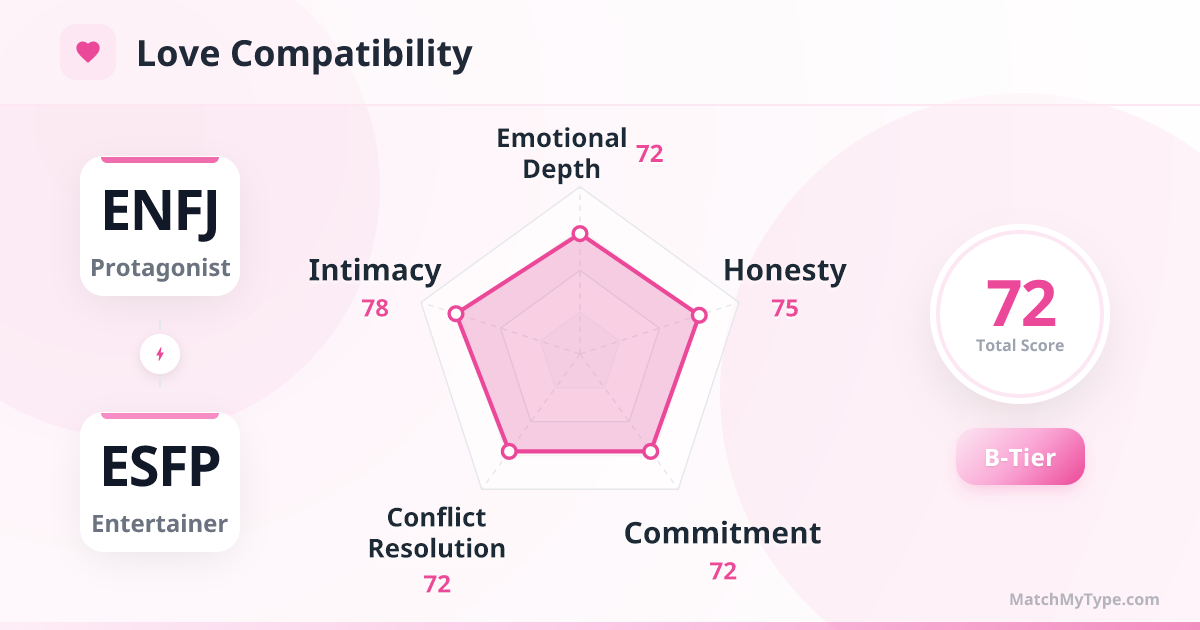
1. Why the Fatal Attraction?
ENFJ often lives under the weight of responsibility and future anxiety, while ESFP is a master of living in the now. ESFP is like a breath of fresh air, untangling ENFJ’s tightly wound nerves and teaching them pure joy. Conversely, while ESFP seems carefree, their inner self (Fi) craves deep attention and validation. An ENFJ partner, who wears their heart on their sleeve and excels at encouragement, perfectly satisfies ESFP’s need for the spotlight. Both are 'sunshine' types with rapid feedback loops, making the honeymoon phase incredibly sweet.
2. The Underlying Battle (Jungian Functions)
The core conflict lies in **Time Perception** and **Values** differences: **Fe (Extraverted Feeling) x Fi (Introverted Feeling)**: ENFJ (Fe) makes decisions based on 'is everyone happy?', while ESFP (Fi) decides based on 'does this feel right to me?'. ENFJ might see ESFP as impulsive or selfish; ESFP might see ENFJ as performative or exhausted by people-pleasing. **Ni (Introverted Intuition) x Se (Extraverted Sensing)**: This is the biggest pain point. ENFJ (Ni) looks at the future, meaning, and growth; ESFP (Se) is immersed in sensory experiences—food, parties, and current vibes. When ENFJ tries to go deep into philosophy, ESFP might interrupt with, 'Stop overthinking, let’s go get hot pot!' This can leave ENFJ feeling intellectually lonely.
Beware the 'Parent Mode.' ENFJ’s anxiety about the future can lead them to micromanage ESFP’s life (finances, schedule). This triggers ESFP’s fierce rebellious streak, turning the relationship into a dynamic between a 'nagging parent' and a 'rebellious teen.'
3. Three Stages of the Relationship
Stage 1: Carnival & Infatuation
They click instantly. Social calendars are packed. ENFJ loves ESFP’s wit; ESFP admires ENFJ’s competence. Every day feels like a festival, full of surprises and romance.
Stage 2: Preaching & Evasion
Reality sets in. ENFJ grows tired of ESFP’s lack of planning and starts 'educational' lectures. ESFP feels pressured and escapes through late nights or partying. The more ENFJ chases, the more ESFP runs.
Stage 3: Acceptance & Balance
ENFJ learns to let go of control and enjoy the moment; ESFP learns to listen to ENFJ on key issues and shows responsibility. They find the golden ratio between 'serious' and 'playful'.
4. Intimacy & Sex
In the bedroom, this pair is electric. ESFP is a master of sensory experience (Se), bringing passion and variety. ENFJ is a loving 'giver,' eager to convey deep emotion through touch. ESFP’s boldness encourages ENFJ to let loose, while ENFJ’s praise boosts ESFP’s confidence. Usually, there are no barriers here—just pure enjoyment.
5. Relationship Landmines
- 1**Depth Mismatch**: ENFJ wants to talk about the meaning of life; ESFP wants to talk about celebrity gossip. ENFJ shouldn't force metaphysics on ESFP—save that for your Ni/Ne friends.
- 2**Financial Friction**: ESFP is prone to impulse spending for instant joy; ENFJ tends to save for the family's future. This is the most common practical argument.
- 3**Social Jealousy**: Both are social butterflies, but ESFP’s boundaries can be blurry for the sake of fun, which might trigger ENFJ’s possessiveness or insecurity.
FAQ
Workplace Collaboration Guide
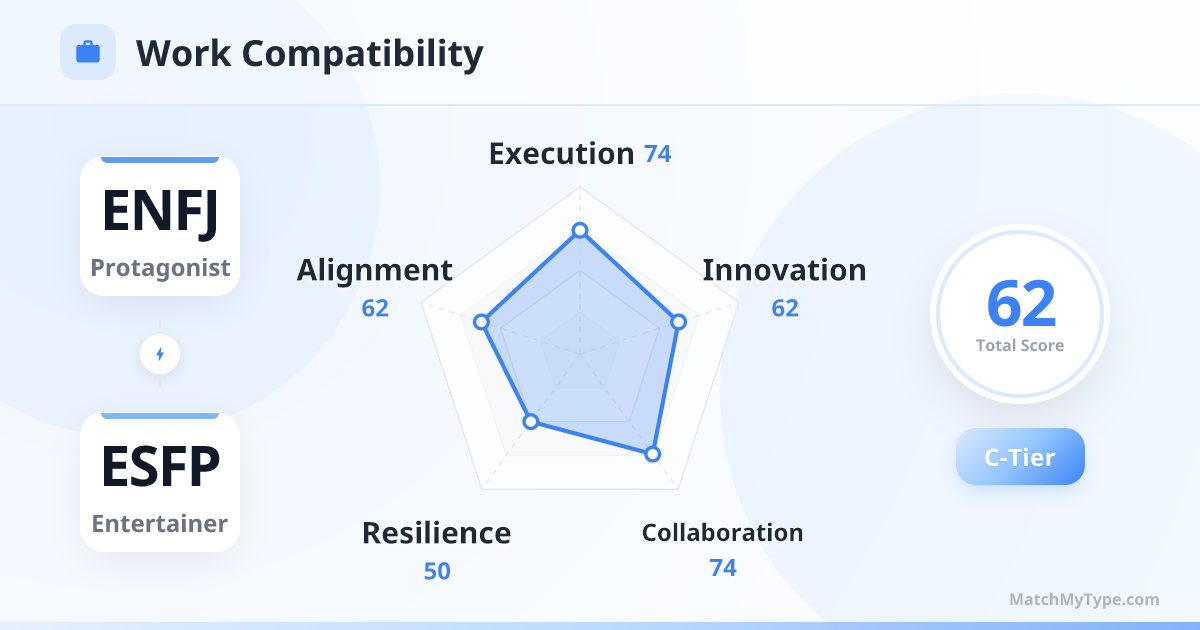
If you form a team, you're best suited for PR, sales, event planning, or entertainment. You are the natural 'hype squad' and the face of the company. However, in projects requiring rigorous logic, dry data, or long periods of isolation, this duo could be a disaster.
Synergy
Ultimate Charisma. ENFJ excels at painting a vision and uniting people, while ESFP is great at working the room and handling interpersonal dynamics. In a roadshow or fundraiser, ENFJ handles the speech while ESFP handles the networking—an unbeatable combo.
Friction
Lack of Logic and Detail. Both lack strong Ti (Introverted Thinking) and Si (Introverted Sensing). Often, ENFJ dreams big and ESFP cheers, but nobody checks the budget or the execution details. The project looks lively but is full of holes.
2. Boss & Peer Dynamics
ENFJ as Boss
The Mentor. ENFJ appreciates ESFP’s energy but can't help 'teaching' them how to be more organized. As long as ESFP delivers, ENFJ is supportive. But if ESFP repeats careless mistakes, ENFJ turns from 'nurturing mother' to 'preaching monk,' which drives ESFP crazy.
ESFP as Boss
The Buddy. ESFP hates hierarchy and focuses on vibes. The ENFJ subordinate becomes the actual 'manager,' filling gaps in long-term planning. ENFJ needs to be careful not to act 'more like the boss than the boss' to save ESFP’s face.
Peers
The Procrastination Partners. If you sit together, productivity might halve because the conversation is too good. Best approach: ENFJ handles processes and external comms; ESFP handles tasks requiring flexibility and personal charm.
3. Communication Manual
- MeetingsKeep them short and punchy. ENFJ shouldn't lecture; ESFP has a limited attention span for theory. Tell them what to do, why it's fun, and what the reward is.
- CriticismESFP is extremely sensitive to criticism (Fi). ENFJ should use the 'sandwich method' and keep the tone light. Don't turn a small mistake into a lecture about 'attitude' or 'the future'.
- Task AllocationGive ESFP tasks involving improvisation, people, and short-term wins. Leave long-term planning, cross-department coordination, and documentation to ENFJ.
4. Mutual Growth
A pairing that 'neutralizes' each other's extremes. ENFJ learns from ESFP how to live in the moment, stop worrying about disasters that haven't happened, and be more authentic. ESFP learns from ENFJ how to consider long-term consequences and organize their thoughts and life more systematically.
FAQ
Social & Entertainment Mode
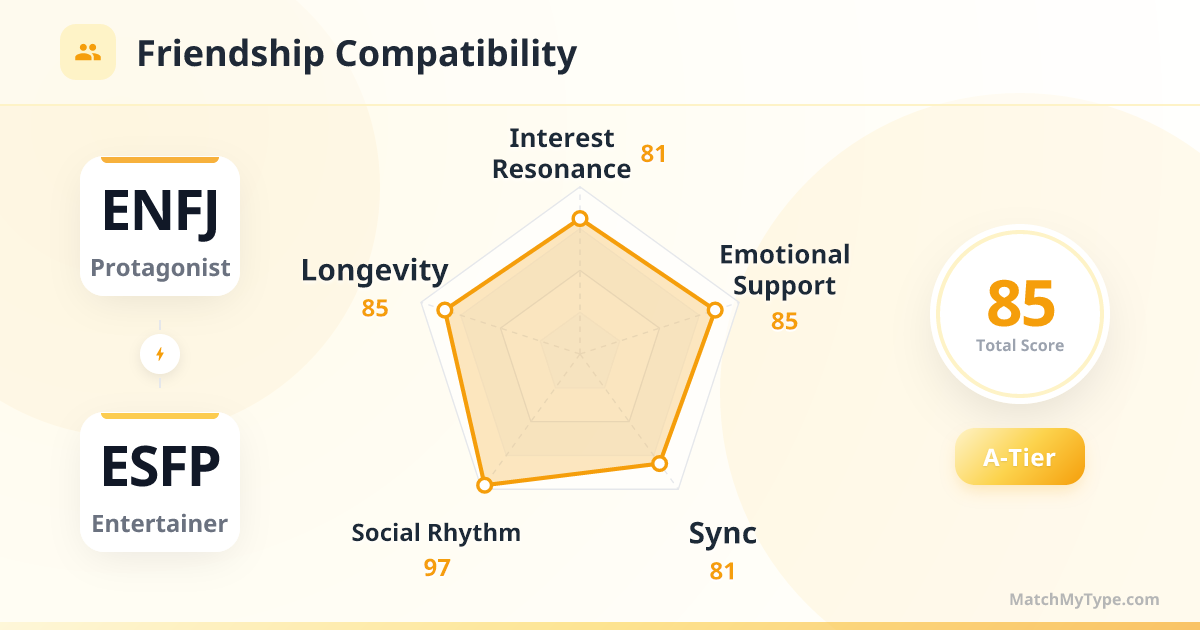
The most enviable playmates in the MBTI universe. Wherever you two are, that's the center of the party. ENFJ loves organizing, and ESFP loves showing up; you can turn a boring Tuesday into a carnival.
1. Social Energy Match
Full match. Both are high-energy extroverts (E) who fear silence and loneliness. ENFJ looks after everyone to ensure no one is left out; ESFP provides the laughs and the highlights. The difference: ENFJ socializes with purpose (networking), while ESFP socializes for fun. When ENFJ is drained (Fe exhausted), watching ESFP perform is healing.
2. Common Interests
You can talk about fashion, celebs, or office politics. Anything sensory is a win. ENFJ loves taking photos of ESFP (who is a natural model); ESFP loves dragging ENFJ into new, thrilling experiences to break their rigid rules.
3. Travel Compatibility
ENFJ loves planning (J) and schedules; ESFP loves sleeping in and stopping for random fun (P). Best plan: ENFJ books the essentials, but only schedules 50% of the day, leaving the rest for ESFP’s spontaneity. If ENFJ forces the itinerary, ESFP snaps; if there's no plan, ENFJ panics. Meet in the middle.
FAQ
Explore More Matches
Discover how these types interact with others