ENTP and ISTJ Compatibility
When the most uncontrollable innovator (ENTP) meets the most meticulous executor (ISTJ), it's more than a clash of ideas and rules—it's a perfect experiment in grounding dreams
Real Stories
Deep Dive: Love and Intimacy
This is a classic 'odd couple' scenario. The ENTP sees the ISTJ as a stiff 'relic,' while the ISTJ views the ENTP as an unreliable 'maniac.' Yet, it is this extreme polarization that creates a lethal attraction. The ENTP brings vibrant color to the ISTJ's black-and-white world, while the ISTJ provides the solid anchor for the ENTP's otherwise drifting existence.
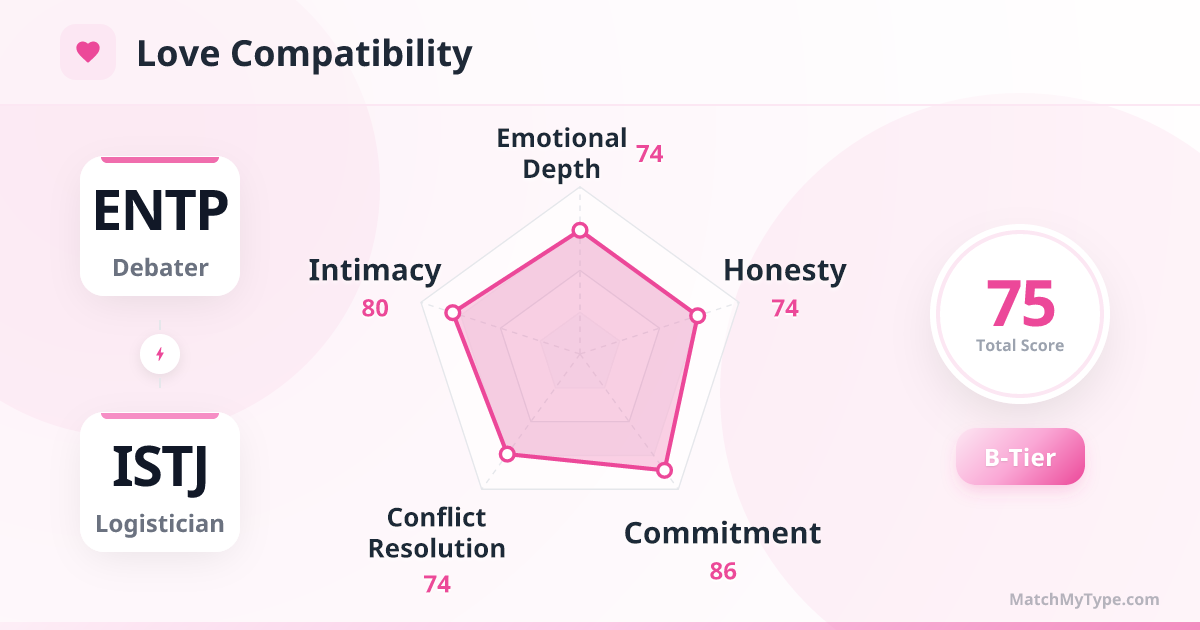
1. Why the Chemistry Sparks?
ENTPs are wired to seek novelty and challenge. They are naturally drawn to the ISTJ's 'calm in the storm' aura, often feeling a mischievous urge to poke the iceberg. Meanwhile, though the ISTJ might grumble about the ENTP's noise, they secretly admire the ENTP's courage to break conventions and their endless stream of ideas. In this relationship, the ISTJ finds the fun they didn't know they were missing, and the ENTP finds the security and order they desperately need.
2. The Cognitive Gambit (Jungian Functions)
This is a showdown between **Ne (Extraverted Intuition)** and **Si (Introverted Sensing)**. **Ne (ENTP) vs Si (ISTJ)**: The ENTP's lead function focuses on possibilities and change; the ISTJ's lead function focuses on past experience and stability. The ENTP wants to try a new fusion restaurant; the ISTJ insists on the same spot they've visited every Friday for five years. This is the core conflict, but if managed well, the ENTP steers the ship while the ISTJ handles the rowing and supplies, making for a fast and stable journey. **Ti (Introverted Thinking) vs Te (Extraverted Thinking)**: ENTPs seek logical consistency and the 'why,' loving to debate truth. ISTJs seek logical efficiency and 'results,' caring only if it works. An ENTP will spend all night debating a theory; an ISTJ will simply ask, 'Will this save us money?'
The biggest risk lies in the low-tier collision of **Fe (Extraverted Feeling)** and **Fi (Introverted Feeling)**. Neither is particularly skilled at handling delicate emotions. Arguments can quickly devolve into 'cold logical brawls,' where they attack each other's intelligence or sense of responsibility, freezing the relationship to a standstill.
3. Three Stages of the Relationship
Stage 1: Curiosity and Impact
The ENTP studies the ISTJ's disciplined life like a scientist discovering a new continent; the ISTJ is impressed by the ENTP's eloquence. Both are fueled by the 'you are so weird' novelty factor.
Stage 2: The Order War
After the honeymoon phase, the ENTP feels suffocated by the ISTJ's rules (toothpaste must be squeezed from the bottom, socks must be sorted). The ISTJ becomes anxious about the ENTP's spontaneity (being late, impulsive spending, changing plans). This is the peak breakup period.
Stage 3: Division and Complementarity
A mature ENTP learns to play within the safety boundaries set by the ISTJ, and a mature ISTJ learns to appreciate the surprises the ENTP brings. They reach a silent agreement: ENTP handles the 'Big Picture' (direction), ISTJ handles the 'Small Stuff' (execution).
4. Intimacy and Sex
In the bedroom, this is a clash of 'exploration' versus 'routine.' The ENTP views sex as a creative, experimental game, enjoying new techniques or roleplay. The ISTJ tends to view it as a stable, bonding ritual, prioritizing comfort and consistency. The key is balance: the ENTP needs to slow down and respect the ISTJ's need for safety, while the ISTJ needs to occasionally step out of their comfort zone to indulge the ENTP's whims. When the ISTJ reveals their hidden passion—usually high-quality endurance and service—the ENTP is often pleasantly surprised.
5. Relationship Landmines
- 1**ENTP's 'Empty Promises'**: Making grand commitments and failing to deliver will cause the ISTJ to lose trust entirely.
- 2**ISTJ's 'Preaching Mode'**: Using 'You should...' or 'The rules say...' to stifle the ENTP's ideas will trigger rebellion and mischief.
- 3**Cold War Conflict Resolution**: Both are highly rational and may retreat into silence during fights. If the ISTJ sulks while the ENTP goes out to party, the rift may become unfixable.
FAQ
Workplace Collaboration Guide
This is one of the most powerful 'entrepreneurial duos' in the MBTI universe. One looks at the stars (strategy), the other looks at the ground (execution). Without the ENTP, the ISTJ might stick to outdated rules; without the ISTJ, the ENTP's company might go bankrupt in three months due to financial chaos.
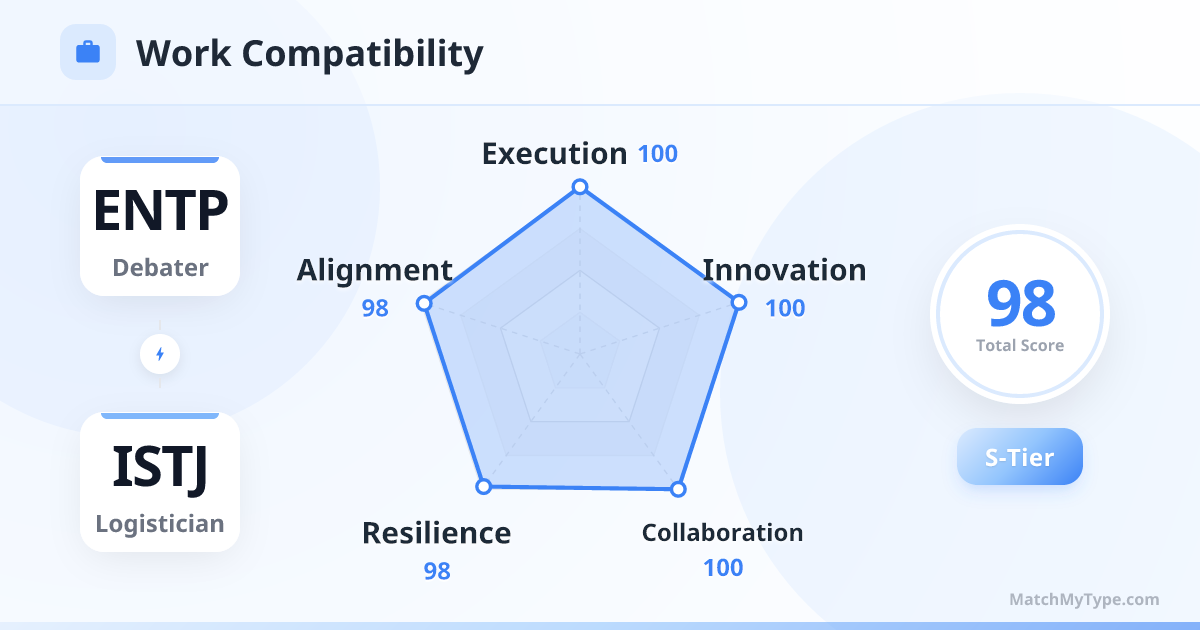
Synergy
A perfect loop. The ENTP excels at 0-to-1 innovation, identifying market pain points and proposing disruptive solutions. The ISTJ excels at 1-to-100 scaling, establishing SOPs, controlling costs, and ensuring quality. ENTP wins the clients; ISTJ wins the operations.
Friction
Conflicts over time management and risk appetite. The ENTP loves changing plans a minute before the deadline (calling it 'inspiration'), which is a heart attack trigger for the ISTJ. The ISTJ's pursuit of zero risk may stifle the ENTP's high-risk, high-reward proposals.
2. Hierarchy and Peer Interactions
ENTP as Boss
Visionary but fickle. They need an ISTJ assistant or VP to 'translate' their commands. When the ENTP says 'We're changing the world,' the ISTJ writes down 'Update Feature A by Wednesday.' The ENTP must avoid changing orders daily to keep the ISTJ sane.
ISTJ as Boss
Rigorous but potentially rigid. They value attendance, reports, and rules. The ENTP subordinate will feel restricted. The ISTJ boss should give the ENTP a 'Special Zone'—judging them on results (KPIs) rather than the process (like clock-in times).
As Peers
The ultimate complement. ENTP leads the brainstorming; ISTJ leads the scheduling. Crucially: ENTP shouldn't mock the ISTJ's rigidity, and ISTJ shouldn't dismiss the ENTP's ideas as unrealistic. Respect the other's expertise in your blind spot.
3. Communication Manual
- Messaging the ISTJBe precise, specific, and organized. Use bullet points. Avoid 60-second voice notes or vague phrases like 'figure it out.' Give clear deadlines and standards.
- Messaging the ENTPGet to the point, and feel free to use humor. Avoid bureaucratic tones or immediate dismissal of their ideas. Explain the 'meaning' or 'challenge' behind a task rather than just the 'rule.'
- Meeting StrategyENTPs tend to go off-topic; the ISTJ should act as the moderator, gently pulling the conversation back to the agenda. ISTJs get bogged down in details; the ENTP should remind the team of the macro goals.
4. Mutual Growth (What to Learn)
**ENTP learns from ISTJ**: How to fully implement an idea, how to manage details to avoid risk, and the power of persistence. **ISTJ learns from ENTP**: How to think outside the box, how to find opportunity in chaos, and how to be flexible when plans inevitably change.
FAQ
Social and Leisure Patterns
Your friendship is usually built on 'intellectual respect' or 'shared interests.' While you might not enjoy the same parties (one wants a club, the other a book), you are each other's most reliable consultants when things get tough.
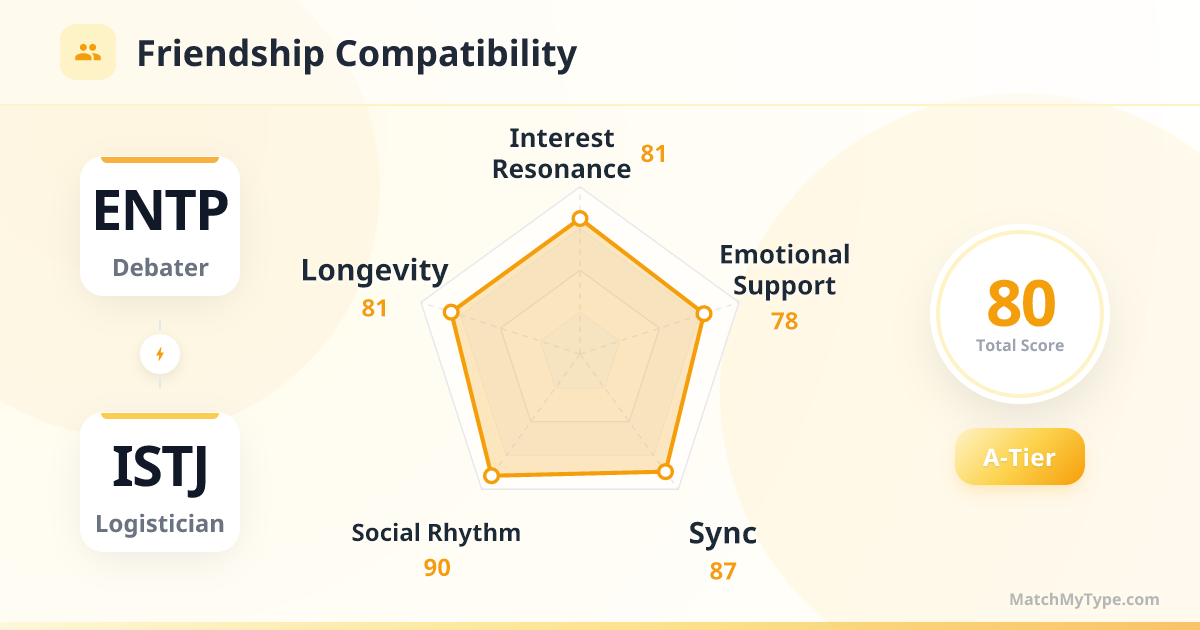
1. Social Energy Match
Completely different frequencies. The ENTP is a social butterfly who gains energy from debate; the ISTJ is a social minimalist who prefers small circles. ENTPs shouldn't force ISTJs into rooms full of strangers, and ISTJs shouldn't always say no. Occasional one-on-one deep dives work much better than group hangouts.
2. Shared Topics and Hobbies
You both love using your brains. Complex strategy games (like Poker or Civilization) are great connectors. ENTP enjoys the gambit; ISTJ enjoys the calculation. You also find common ground in roasting inefficient systems—ENTP thinks they're stupid, ISTJ thinks they're wasteful.
3. Travel Compatibility
ENTP likes to 'go and see,' deciding the mood upon arrival. ISTJ makes an Excel sheet three months in advance, timed to the minute. If traveling together: ISTJ handles bookings (to ensure they aren't homeless), and ENTP handles local exploration and emergencies. Always leave 'Free Exploration Time' for the ENTP.
FAQ
Explore More Matches
Discover how these types interact with others