ESTP and ISTJ Compatibility
One turns life into an action movie (ESTP), while the other ensures it doesn't become a disaster flick (ISTJ)—the ultimate duo for thriving in a cutthroat world
Real Stories
Deep Analysis of Romance & Intimacy
The union of ESTP and ISTJ is like fire meeting rock. ESTP tries to ignite life, while ISTJ tries to build the foundation for the future. This isn't a flowery romance; it's a live-action documentary full of stunts and daily chores. As long as you balance 'change' and 'consistency,' you are the most solid community of interests.
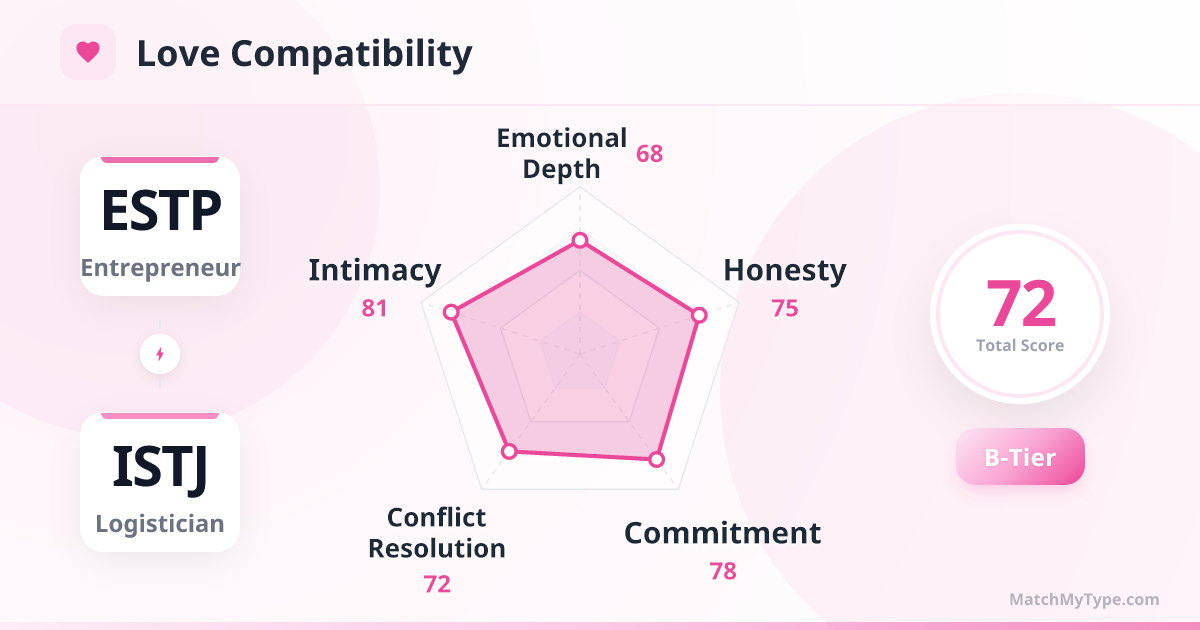
1. Why the Spark?
This is the fatal attraction of 'freedom' and 'order.' ISTJ often lives within strict boundaries and secretly admires ESTP's courage to break rules and live with such vitality; ESTP is drawn to ISTJ's calm, reliable ability to keep everything running like clockwork. For ESTP, ISTJ is a harbor that never collapses; for ISTJ, ESTP is the window through which they see the world.
2. The Brain's Game (Jungian Functions)
You are both masters of reality, but your directions are polar opposites: **Se (Extraverted Sensing) x Si (Introverted Sensing)**: This is the biggest point of conflict and complementarity. ESTP's Se craves immediate thrills, novelty, and instant gratification; ISTJ's Si seeks past experience, stability, and long-term planning. ESTP thinks ISTJ is an 'old-fashioned stick-in-the-mud,' while ISTJ thinks ESTP is 'reckless and inconsistent.' **Ti (Introverted Thinking) x Te (Extraverted Thinking)**: ESTP's Ti likes to figure out 'how this thing works' (internal logic); ISTJ's Te cares about 'how this thing is most efficient' (results-oriented). The good news is you are both thinkers (T-types). Arguments are usually about facts, not feelings, allowing for quick logical resolutions without endless emotional drain.
The biggest hidden danger lies in the misalignment of **Fe (Extraverted Feeling)** and **Fi (Introverted Feeling)**. ESTP might use smooth social talk (Fe) to brush things off, which triggers ISTJ's rigid adherence to sincerity and principle (Fi). ISTJ's stubbornness can sometimes make ESTP feel like they're talking to a brick wall.
3. Three Stages of the Relationship
Phase 1: The Complementary Honeymoon
ESTP takes ISTJ to new restaurants and activities; ISTJ enjoys being led and happily plans the logistics. ESTP feels they've found the perfect manager/partner, and ISTJ feels life finally has some color.
Phase 2: The War of Order
ESTP's stray socks, sudden parties, and unplanned spending start hitting ISTJ's limits. ISTJ tries to set rules (curfews, budgeting, chore charts), and ESTP feels suffocated, either rebelling or avoiding coming home.
Phase 3: Division of Labor and Coexistence
If you survive the friction, you reach a silent agreement: ISTJ handles the big stuff (house, investments), and ESTP handles the fun (travel, social life). ESTP learns to check in, and ISTJ learns to look the other way occasionally. You become a power duo that knows how to both make money and enjoy it.
4. Intimacy and Sex
As two S (Sensing) types, your physical chemistry is usually very high, both prioritizing sensory experience and physical contact. ESTP is a natural adventurer, bringing new ideas and passion to the bedroom as the aggressor. ISTJ may seem conservative on the surface, but they have incredible endurance and are very cooperative; once security is established in a private space, they reveal a hidden intensity. ESTP helps ISTJ unlock physical pleasure, while ISTJ provides ESTP with stable, lasting satisfaction. However, ESTP should be careful not to be too aggressive and scare ISTJ, while ISTJ needs to occasionally step out of their comfort zone to match ESTP's playfulness.
5. Relationship Landmines
- 1**Financial Clashes**: ESTP follows 'easy come, easy go,' while ISTJ follows 'save for a rainy day.' This is the most common trigger for breakups.
- 2**Plans vs. Spontaneity**: ISTJ hates last-minute changes; ESTP hates following a script. If ESTP cancels a date or shows up late, ISTJ will be livid.
- 3**Social Battery Mismatch**: ESTP recharges through socializing; ISTJ sees 'useless' socializing as a drain. Forcing ISTJ into a loud party or forcing ESTP to stay home all weekend will cause friction.
FAQ
Workplace Collaboration Guide
This is the most efficient 'Wild Growth x Standardized Management' combo in the workplace. If you start a business together, your success rate is incredibly high. ESTP hunts the prey; ISTJ cures, stores, and distributes the meat.
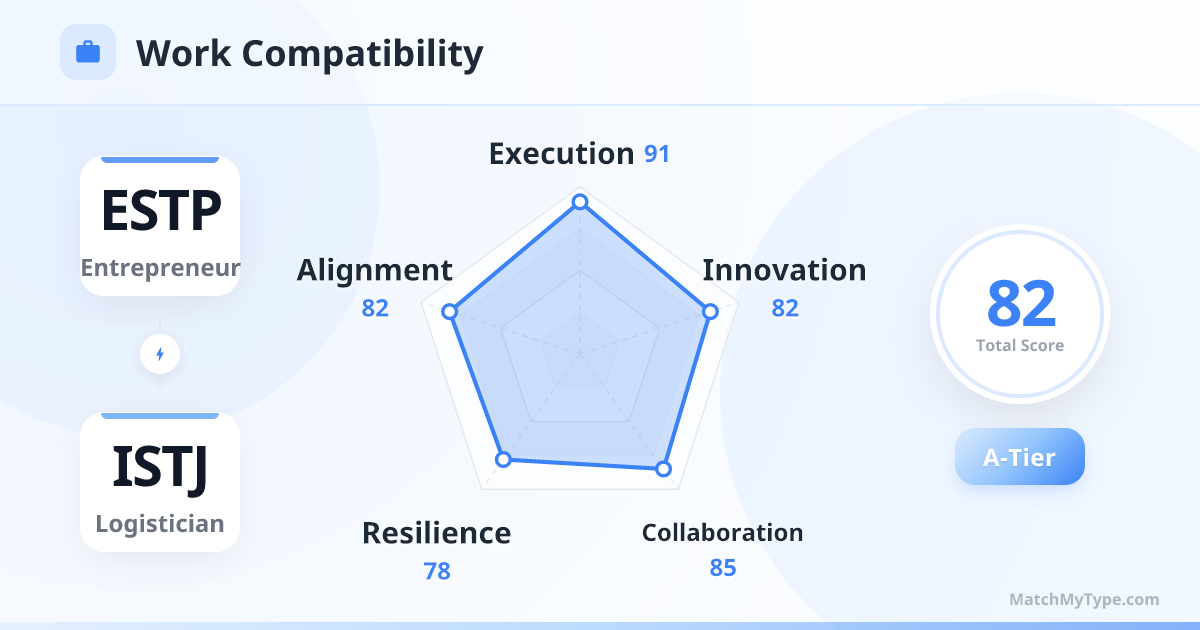
Synergy
The ultimate revenue-generating and cost-cutting machine. ESTP is a natural sales and PR genius, great at breaking the ice and handling crises; ISTJ is the perfect COO or CFO, great at building processes and ensuring quality. ESTP charges ahead while ISTJ supplies the ammo.
Friction
Disregard for rules vs. Worship of rules. ESTP tends to 'act first, ask later,' bypassing rules to get results. ISTJ views rules as sacred. When ESTP promises a client an 'impossible deadline,' ISTJ will lose their mind over the process failure and accuse ESTP of being irresponsible.
2. Hierarchy & Peer Interaction
ESTP as Boss
Wolf leadership. The ESTP boss values results and speed over excuses. An ISTJ subordinate will be highly valued for their reliability, but they must adapt to the boss's changing mind and help turn the boss's wild ideas into executable plans.
ISTJ as Boss
Systemic leadership. The ISTJ boss values attendance, reports, and procedures. This is hell for an ESTP subordinate. ISTJ should set clear KPIs and then give ESTP the freedom to hit them their own way, rather than obsessing over what time they clocked in.
As Peers
Complementary but distant. Physical separation is best: send the ESTP into the field and keep the ISTJ in the office. In meetings, ESTP provides the ideas and energy, while ISTJ provides the reality check. As long as they don't micromanage each other's methods, they can coexist peacefully.
3. Communication Manual
- Email/Messaging StyleBe concise. No long-winded fluff; use bullet points. Give ISTJ a hard deadline; give ESTP a clear benefit.
- Conflict ResolutionUse data and facts. Don't talk about feelings. If ESTP wants to convince ISTJ, bring an Excel sheet and a risk assessment. If ISTJ wants to convince ESTP, tell them how much money it saves or makes.
- Meeting StrategyESTP tends to go off-topic; ISTJ needs to act as the moderator to pull the conversation back to the agenda. ISTJ should avoid nitpicking details in public to save ESTP's face; handle details in private.
4. What Can You Learn From Each Other?
**ESTP learns from ISTJ**: Patience, focus, and risk control. Learning to pause for three seconds before acting and how to see a boring task through to the end. **ISTJ learns from ESTP**: Flexibility, adaptability, and improvisation. Learning not to panic when plans change, enjoying the chaos, and how to sell themselves more confidently.
FAQ
Social & Entertainment Mode
You are friends who actually 'get things done.' You might not spend all night discussing the philosophy of life, but if you need to renovate a house, build a PC, or survive a camping trip, there is no stronger team.
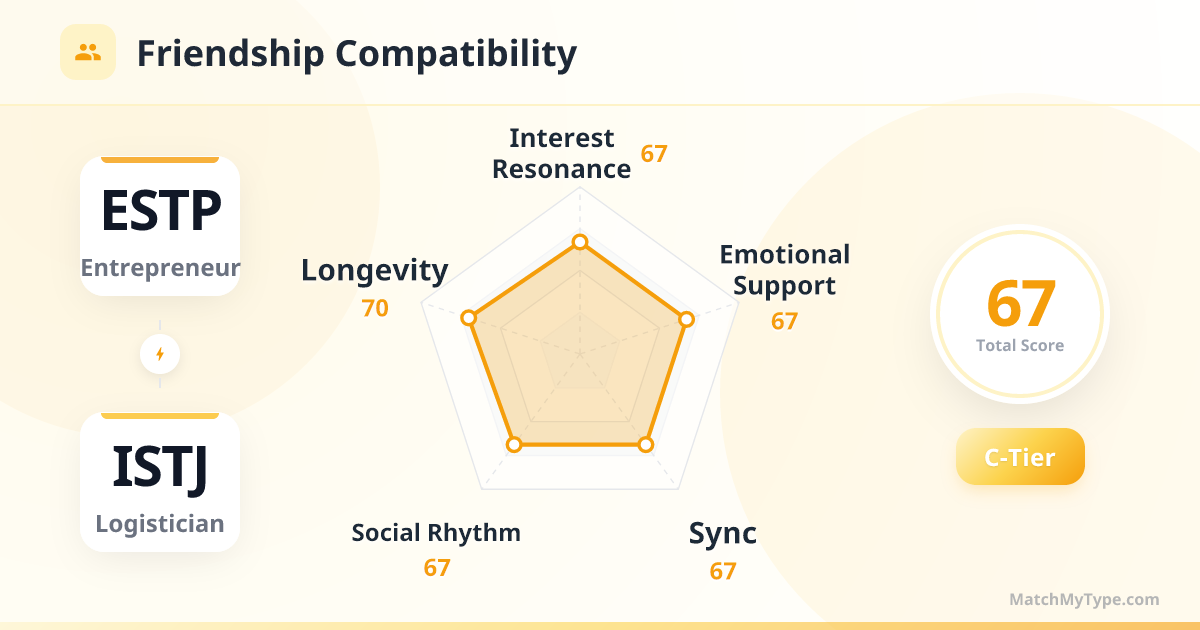
1. Social Energy Match
ESTP is the party animal; ISTJ is the lone wolf. In a friendship, ESTP often plays the 'bad influence,' dragging ISTJ out to see the world. ISTJ grumbles but goes along, usually ending up being the one who carries the drunk ESTP home. This 'frenemy' dynamic is solid because ESTP needs an audience and ISTJ needs someone to push them out of their shell.
2. Shared Hobbies
You both live in the physical world (S-types). Abstract philosophical debates will put you both to sleep. But if you talk about stock trends, car performance, the latest tech reviews, or go skiing together, you'll have endless things to talk about. This friendship is built on 'doing' rather than 'sharing feelings.'
3. Travel Compatibility
This is the classic 'spontaneous trip' vs. 'Excel demon.' ESTP buys tickets at the airport; ISTJ plans three months in advance. The best plan: ISTJ handles flights, hotels, and transport (the safety net), and ESTP finds the cool restaurants and spontaneous spots once you arrive (the surprise). ESTP must respect the schedule, and ISTJ must leave room for some 'planned chaos.'
FAQ
Explore More Matches
Discover how these types interact with others