ESFP and INFJ Compatibility
ESFP drags INFJ into the sensory world while INFJ provides a soul anchor when ESFP gets lost—a collision of sensory feast and spiritual depth
Want specific advice?
Generate a unique analysis report based on star sign, blood type, identity, and gender.
Romantic & Intimacy Depth Analysis
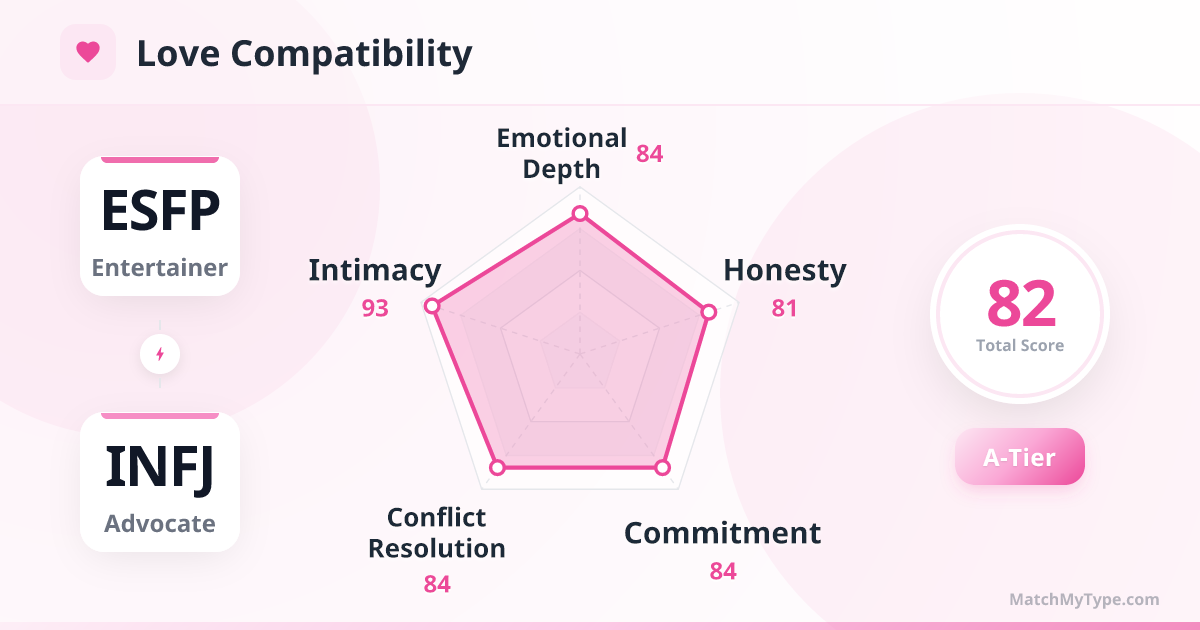
This is a classic 'complementary' pair. ESFP is like a sudden burst of colored laser in INFJ's gray world, while INFJ is the peaceful harbor ESFP craves after a noisy day. This attraction often starts with curiosity but requires immense patience to sustain.
1. Why the Fatal Attraction?
INFJs often live inside their own heads and the future, which can feel heavy and anxiety-inducing. The arrival of an ESFP doesn't just bring joy; it forces the INFJ to 'live in the moment.' This pure vitality and bias toward action is an irresistible temptation for the INFJ. Conversely, while ESFPs may seem carefree, they often lack internal security and direction. The INFJ's deep insight, mystery, and the 'I understand the sadness behind your smile' empathy will make an ESFP fall instantly.
2. The Cognitive Tug-of-War (Jungian Functions)
This is a high-stakes match between **Se (Extraverted Sensing)** and **Ni (Introverted Intuition)**: **Se-dom x Se-inferior**: ESFPs are masters of the senses, experiencing the world through sound, taste, and touch. The INFJ's inferior Se often causes them to ignore physical reality. The ESFP helps ground the INFJ with good food and beautiful sights. However, if the ESFP chases too much sensory thrill (like all-night parties or impulsive spending), it will drain the INFJ's battery. **Ni-inferior x Ni-dominant**: INFJs always look past the surface to see the essence and long-term meaning. The ESFP's inferior Ni makes them find abstract, distant futures headache-inducing or even scary. When an INFJ tries to discuss cosmic philosophy or a ten-year plan, the ESFP might think, 'That's too heavy; let's just figure out what's for dinner.' **Fi (Introverted Feeling) x Fe (Extraverted Feeling)**: ESFPs insist on being their authentic selves (Fi), doing whatever makes them happy. INFJs prioritize the feelings of others (Fe) to maintain harmony. This can lead to the INFJ viewing the ESFP as 'selfish,' while the ESFP sees the INFJ as 'fake' or 'exhausting to be around.'
3. Three Stages of the Relationship
Stage 1: The Technicolor Filter
ESFP takes INFJ on wild adventures; INFJ feels the world is finally vivid. ESFP views INFJ as a mysterious, wise sage. Both are intoxicated by the novelty of their differences.
Stage 2: The Depth Gap
After the honeymoon phase, INFJ craves deep spiritual exchange but finds ESFP diverting to gossip or jokes, leading to loneliness. ESFP grows tired of INFJ's melancholy and 'preaching,' feeling suffocated and wanting to escape back to fun.
Stage 3: Dynamic Equilibrium
If they survive the friction, INFJ learns to let go and enjoy the present, while ESFP learns to pause and listen to INFJ's intuitive warnings. They become the 'kite and the string': ESFP is the kite, INFJ is the line.
4. Intimacy and Sex
In the bedroom, the ESFP is the natural lead and fire-starter. They focus on immediate sensory pleasure, atmosphere, lighting, and physical touch, which helps the over-thinking INFJ return to their body and experience pure pleasure. The INFJ, in turn, brings emotional depth and a sense of the sacred to the act. If the INFJ can relax their nerves, their intimate life will be a perfect blend of passion and tenderness.
5. Relationship Landmines
- 1**The INFJ 'Parental' Lecture**: INFJs can easily slip into 'monk mode' when they disapprove of ESFP's impulsiveness, which instantly triggers ESFP's rebellious streak.
- 2**ESFP's Depth Avoidance**: When an INFJ wants to seriously discuss relationship issues, the ESFP's tendency to joke or change the subject can make the INFJ feel hopeless.
- 3**Social Energy Mismatch**: ESFP drags INFJ to a five-hour party; INFJ runs out of battery halfway through and shuts down; ESFP feels like their buzz is killed, leading to a bitter end to the night.
FAQ
Workplace Collaboration Guide
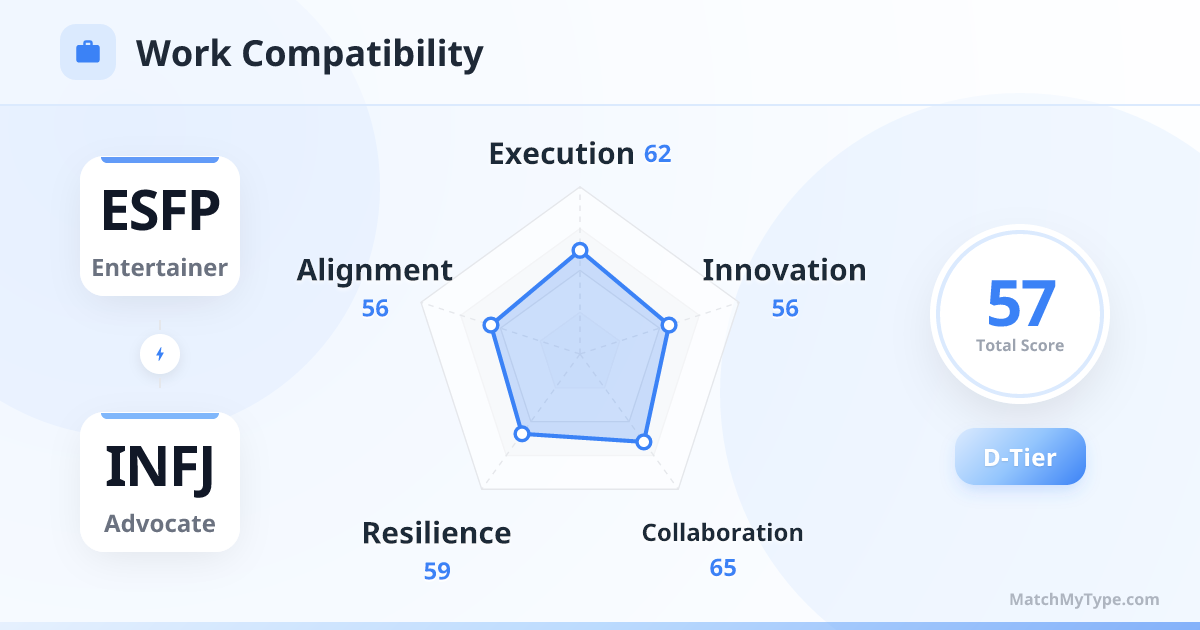
This is the ultimate 'Frontstage' and 'Backstage' duo—the meeting of the 'Doer' and the 'Strategist.' If coordinated well, you can dominate sales, PR, or entertainment. If not, it’s a 'No Brains vs. No Fun' disaster.
Synergy
ESFPs have incredible charisma and infectious energy, perfect for roadshows, sales, and crisis PR. INFJs excel at strategic planning, reading people, and building long-term visions. INFJ writes the script, ESFP delivers the performance—a golden partnership.
Friction
A total mismatch in communication dimensions. ESFP is about 'fast, now, and concrete'; INFJ is about 'steady, future, and macro.' In meetings, ESFP may find INFJ's theories impractical, while INFJ sees ESFP as short-sighted. Both lack Te (efficiency and logical critique), meaning projects can spiral into chaos or get bogged down in office politics.
2. Hierarchy and Peer Interaction
ESFP as Boss
The 'Inspirational Cheerleader.' ESFP bosses create a great vibe but may change orders on a whim. The INFJ subordinate needs to act as the 'hidden advisor,' recording inspirations and gently reminding the boss of long-term risks. Never contradict an ESFP's optimism in public.
INFJ as Boss
The 'Visionary Leader.' INFJs can think too much and do too little, or give vague instructions. The ESFP subordinate is the best 'icebreaker' and 'executor,' quickly selling the INFJ's concepts. INFJ bosses must give ESFPs instant feedback and public praise—it's their fuel.
Peer Colleagues
Complementary but needs boundaries. Split tasks physically: give the people-facing, high-energy work to the ESFP; give the material-writing, planning, and analysis to the INFJ. Avoid having both handle data work that requires rigorous logical auditing.
3. Communication Manual
- Advice for ESFPThink before you speak to an INFJ. If you need to change a plan, explain the 'why' beforehand. INFJs hate sudden surprises.
- Advice for INFJTalk less about theory and more about specific examples. When criticizing an ESFP, always acknowledge their effort first, or they will emotionally shut down and stop listening.
- Meeting StrategyLet the ESFP handle the atmosphere and brainstorming; let the INFJ handle the documentation and final synthesis. Don't let the ESFP lead the second half of the meeting, or it will never end.
4. What Can They Learn? (Growth Perspective)
ESFPs can teach INFJs that sometimes 'thinking' doesn't solve problems, but 'doing' does; that joy itself is a form of productivity; and how to connect effortlessly with strangers. INFJs can teach ESFPs to think one step ahead; how to see true motives behind appearances; and the value of solitude and deep reflection.
FAQ
Social & Entertainment Mode
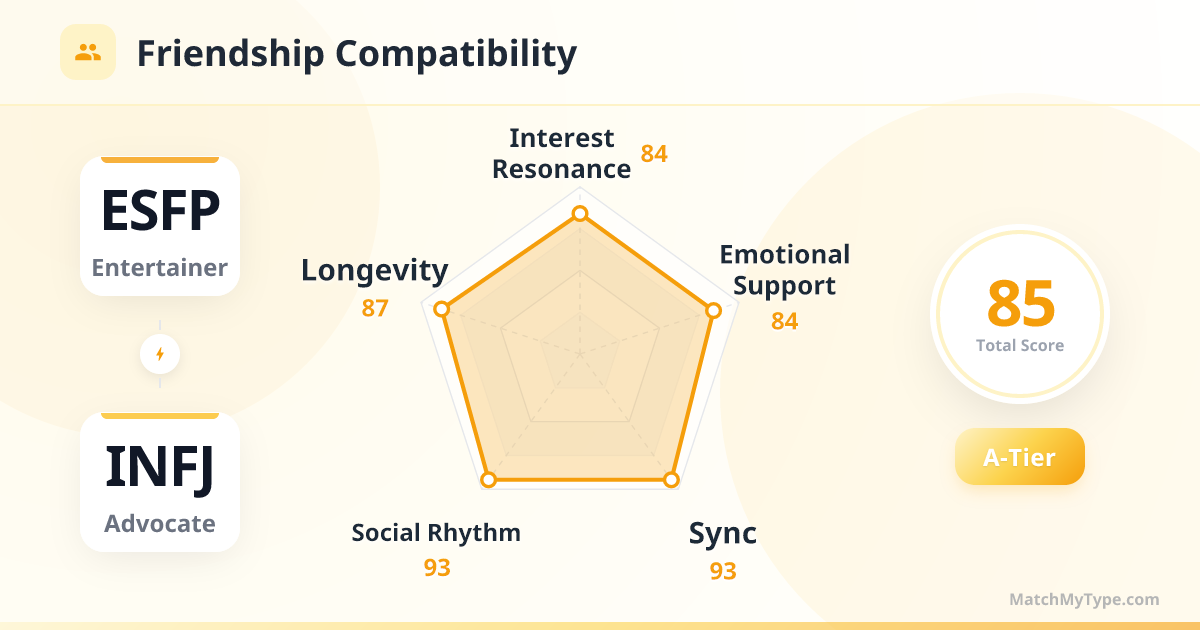
You are the most fascinating duo in any friend group. ESFP is the one who drags you out of bed to see the sunrise at the beach; INFJ is the one who sits with you during that sunrise and muses on the impermanence of life.
1. Social Energy Match
Highly mismatched but compatible. ESFP recharges through social interaction; INFJ recharges through solitude. The best mode: ESFP goes to the party, then returns with stories and snacks for the INFJ, and they share them in a quiet corner. Or, ESFP acts as the INFJ's 'social spokesperson' and shield in crowded settings.
2. Common Interests
Music and art are your universal languages. ESFPs have a keen intuition for fashion and aesthetics (Se), while INFJs have a unique understanding of the mood behind the art (Ni). Going to exhibits or live houses together is a fantastic choice.
3. Travel Compatibility
ESFP travel is 'special forces' style: photos, clubs, surfing, and a packed itinerary. INFJ travel is 'healing' style: watching the sea, zoning out, and sitting in cafes. If traveling together, spend half the day on activities (for ESFP) and half the day resting (for INFJ). Don't force the INFJ to a bar at night—that's their nightmare.
FAQ
AI Deep Pairing Analysis
Provide more details allow AI to give precise compatibility guidance based on ESFP x INFJ, zodiac, and blood type.
ESFP Info
INFJ Info
*Unlock detailed character & complement analysis
Explore More Matches
Discover how these types interact with others