INFJ and INFJ Compatibility
Like two people examining each other's souls with magnifying glasses: the world's most intuitive confidants and the most likely accomplices in an emotional whirlpool
Real Stories
In-Depth Romantic & Intimacy Analysis
The meeting of two INFJs is often described as 'finally finding that long-lost twin.' In a world full of misunderstandings, you are each other's only safe harbor. This relationship needs few words; a single look can convey a thousand. However, two deep whirlpools spinning too close can trigger a massive emotional tsunami.
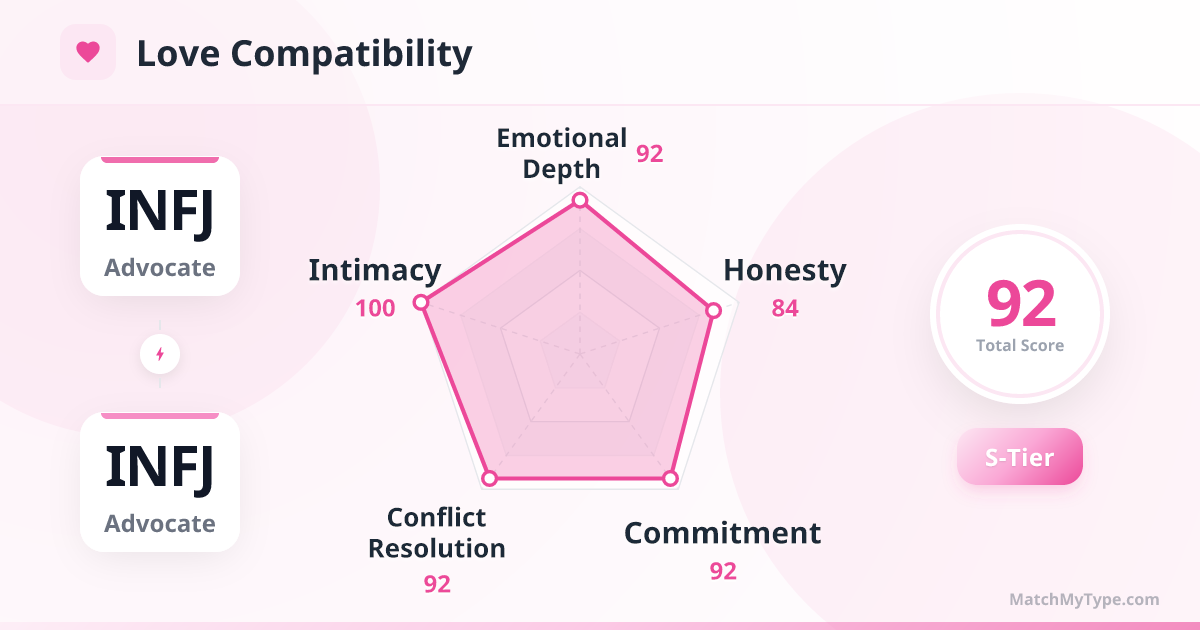
1. Why the Fatal Attraction?
It's a 'mask-off' carnival. INFJs spend their lives adjusting themselves (Fe) to be the perfect friend, employee, or partner, feeling profoundly lonely inside. When you meet another INFJ, the disguise fails—because they see right through you. This feeling of being 'nakedly seen' is both terrifying and incredibly healing. You instantly recognize each other's high sensitivity and moral compass, creating a fated sense of belonging.
2. The Cognitive Power Play (Jungian Functions)
A stack of identical functions brings ultimate resonance, but also ultimate blind spots: **Ni (Introverted Intuition) x Ni**: Two supercomputers linked together, simulating endless future possibilities. Your conversations are metaphorical and philosophical, as if living in the clouds. The risk is detaching from reality and falling in love with the 'imagined relationship' rather than the 'real interaction.' **Fe (Extraverted Feeling) x Fe**: The trickiest part. Both crave harmony and want to care for the other's emotions. This often turns into a 'politeness contest'—A sacrifices for B, B sacrifices for A, and eventually both feel resentful but say nothing. This 'toxic harmony' is a silent killer. **Se (Extraverted Sensing) Deficiency**: As a shared inferior function, you will struggle with the mundane details of life—money management, chores, and bills. You might discuss the meaning of the universe with passion while the sink overflows with dirty dishes.
Beware of 'Mind-Reading Dependency.' Because you understand each other so well, you might stop verbalizing your needs, assuming 'they should just know.' When they don't, the disappointment is magnified.
3. Three Stages of the Relationship
Stage 1: The Soul Mirror
Initially, you are shocked by the similarity, as if looking in a mirror. This familiarity leads to a rapid fall into love, believing you've found the only person who truly understands you.
Stage 2: Projection & Disillusionment
The hardest period. You begin to see your own disliked traits (sensitivity, hesitation, moodiness) in your partner. It's like seeing flaws in a mirror; you subconsciously resent them because you resent those parts of yourself. Conflict avoidance leads to a backlog of issues.
Stage 3: Silent Guardianship
If you survive disillusionment, you build a deep, comrade-like bond. You stop demanding perfection and instead become each other's strongest shield against the world's indifference. This love is quiet, deep, and unwavering.
4. Intimacy and Sexuality
For a double INFJ pair, sex is more than physical; it's a sacred ritual. Foreplay often begins with deep intellectual exchange. In bed, both are hyper-focused on the other's satisfaction (Fe), sometimes to the point of neglecting their own pleasure. While this 'service-oriented' approach is tender, it can lack raw passion. We suggest introducing 'selfish' moments or using roleplay to release the suppressed Se (sensory exploration).
5. Relationship Landmines
- 1**The Silent Treatment Loop**: When conflict arises, both tend to withdraw and 'Door Slam.' This leads to a deadlocked silence where neither wants to break the ice first.
- 2**The Emotional Sponge Effect**: Both are emotional sponges, absorbing each other's negativity. If one gets depressed, the other is quickly dragged down, creating a spiral of shared gloom.
- 3**The Collapse of Reality**: Forgetting bills, missing appointments, a messy home... the loss of control over life's details triggers anxiety, which often turns into mutual blame.
FAQ
Workplace Collaboration Guide
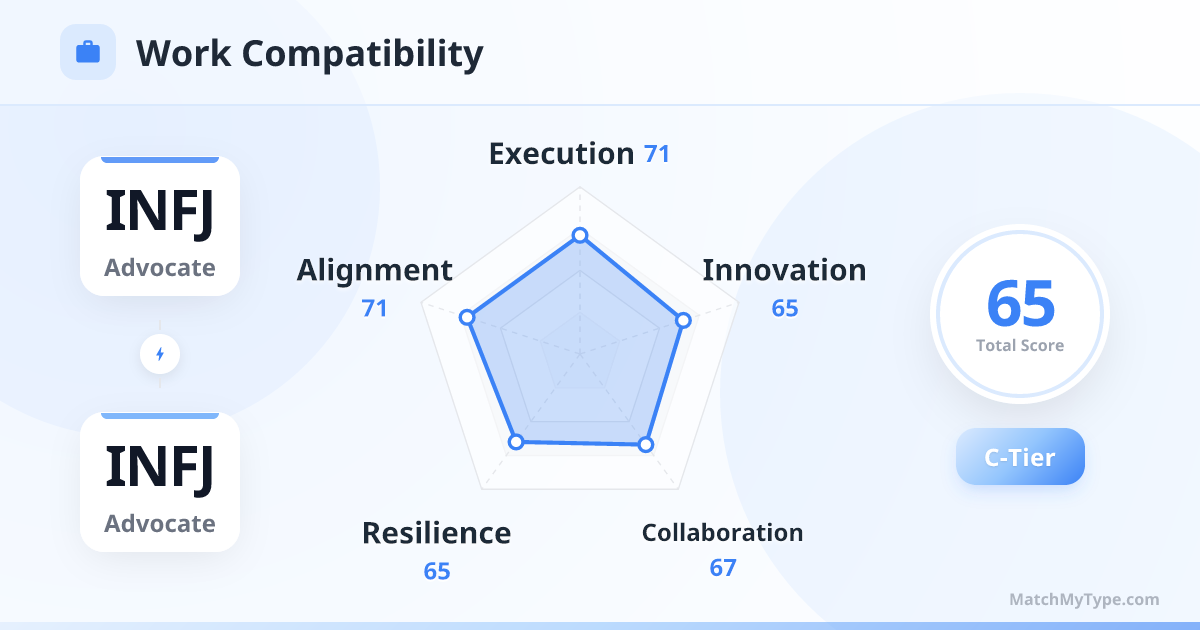
In the workplace, the INFJ-INFJ duo is the classic 'Dream Factory.' You have the perfect vision, high values, and deep insights, but you often lack the 'bricklayer' spirit to make it real. Without someone tracking the progress bar, projects may stay in the 'perfect concept' phase forever.
Synergy
Unspoken chemistry and high moral ground. In fields like humanitarian work, counseling, arts, or non-profits, you are a golden duo. You instantly grasp each other's abstract concepts and build deeply meaningful solutions. You will never sell out your values for profit.
Friction
Paralysis by perfectionism. Both want things to be perfect (Ni obsession), leading to endless tweaking of details and delayed delivery. Additionally, both fear conflict; when facing a 'difficult' team member or unreasonable client, you might pass the buck, as neither wants to be the 'bad guy.'
2. Hierarchy & Peer Interaction
A as Boss (INFJ)
A Zen-like but high-pressure leader. The INFJ boss is gentle but has extremely high internal standards. The INFJ subordinate will acutely sense unspoken dissatisfaction, leading to immense psychological pressure. The boss should express criticism clearly rather than making the subordinate guess.
B as Boss (INFJ)
Same as above. In this pairing, professional boundaries can blur. You might spend hours discussing the meaning of life in the office, compressing actual work time. Deliberate professional boundaries are necessary.
Peer Colleagues
Best as a 'behind-the-scenes think tank.' Don't put yourselves in roles requiring high-frequency social interaction, cold calling, or tedious admin. Let two INFJs hide in a conference room for strategic planning or content creation for maximum efficiency.
3. Communication Manual
- Email/Messaging StyleLong-winded and overly polite. Your chat history is likely full of 'Sorry,' 'If it's convenient for you,' and 'In my personal opinion.' Suggestion: Try cutting your word count in half and getting straight to the point.
- Meeting StrategyProne to tangents. Moving from project budgets to the future of humanity is common. You must set a hard timer for the agenda or bring in an STJ-type colleague as a 'sergeant-at-arms' for discipline.
- Feedback StyleExtremely sensitive. When giving feedback, layer it with plenty of affirmation. Direct negation is often interpreted as a personal attack. Use 'If we try it this way, would it be closer to our vision?' instead of 'This is wrong.'
4. Mutual Growth (The Growth Perspective)
In this professional relationship, you are actually learning 'how to live with yourself.' Seeing your partner miss opportunities due to indecision makes you realize your own need for decisiveness; seeing them exhausted from over-empathy teaches you to set boundaries. You are each other's best mirrors, correcting your professional habits by observing each other's struggles.
FAQ
Social & Leisure Patterns
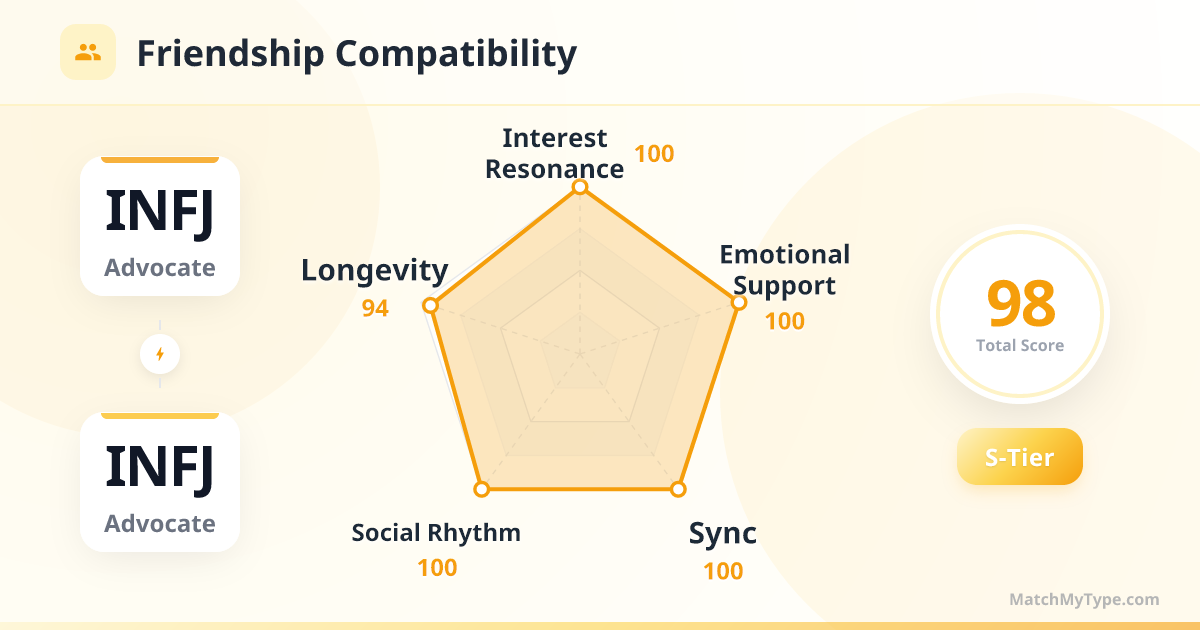
This is a classic 'friendship like water, but once met, thick as wine.' You might not talk for months, but the moment you meet, you skip the small talk and dive straight into the deep end. You are each other's sentinels in the spiritual wasteland.
1. Social Energy Match
A perfect 'low-battery mode' match. You both know how draining socializing is, so you'll never force each other into crowded events. Your hangouts are quiet and private. Best of all, when one wants to go home, the other feels relieved rather than offended, saying: 'Great, I was just thinking the same thing.' This deep understanding of the 'need for solitude' is your greatest asset.
2. Common Topics & Hobbies
Your conversations revolve around 'Why': Why do people act this way? What is the meaning of the universe? Visiting niche museums or reading silently in a cafe with occasional exchanges is high-quality companionship. INFJs also often share a natural interest in the occult (Tarot, Astrology).
3. Travel Compatibility
You both hate 'check-list' style tourism. For you, travel is about thinking about life in a different location. You'll spend an afternoon staring at the sea or getting lost in the alleys of an old town. The only issue is that due to a lack of Se and Te, you might miss a train because you misread the map or the time. Double-check your tickets at least three times.
FAQ
Explore More Matches
Discover how these types interact with others