ESFP and INTP Compatibility
One tries to turn life into a party (ESFP), the other tries to deconstruct the universe into formulas (INTP)—this is the ultimate 'cross-species' communication in the MBTI world
Real Stories
Deep Dive into Romance and Intimacy
This is a classic story of the 'Life of the Party' meeting the 'God of Geeks.' ESFP is the spotlight in the center of the stage, while INTP is the programmer in the corner backstage. This massive gap creates fatal attraction initially—ESFP finds INTP mysterious and brilliant, while INTP finds ESFP vibrant and dazzling. However, over time, this is also the pairing most likely to collapse due to 'failing to understand how the other's brain works.'
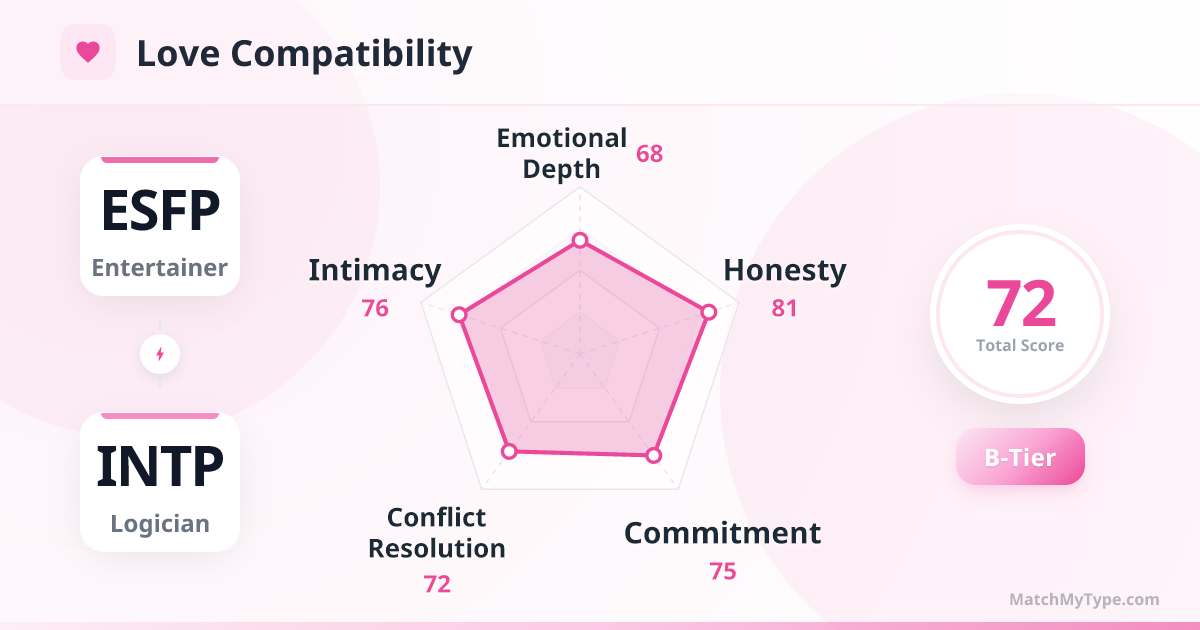
1. Why the Fatal Attraction?
This is a synergy of 'Senses' and 'Thought.' INTP lives in an abstract world of theory, often feeling physically stiff and detached. The exuberant vitality and 'living in the moment' (Se) of the ESFP can instantly pull the INTP back to Earth to experience the thrill of being alive. Conversely, ESFPs are often drawn to the INTP's deadpan humor, encyclopedic knowledge, and the steady 'I'm still calm no matter how much you act out' vibe. ESFP sees INTP as a puzzle to be solved; INTP sees ESFP as the perfect specimen for observing human behavior.
2. The Battle of the Brains (Jungian Functions)
This pair has almost no overlap in cognitive functions, which is both the spark and the source of disaster: **Se (Extraverted Sensing) x Ne (Extraverted Intuition)**: ESFP lives in the 'here and now,' focusing on tangible reality; INTP lives in 'future possibilities,' focusing on abstract concepts. ESFP thinks INTP overthinks and is unrealistic; INTP thinks ESFP is shallow and only cares about pleasure. Communication often feels like being on different frequencies. **Fi (Introverted Feeling) x Ti (Introverted Thinking)**: This is the biggest friction point. ESFP makes decisions based on 'Do I like this?' or 'Does this align with my values?'; INTP decides based on 'Is this logically consistent?' or 'Is it objectively correct?' When ESFP seeks emotional comfort, INTP often throws back cold logical analysis, making ESFP snap: 'I just wanted a hug, why are you giving me a lecture?'
Since both lack dominant **Fe (Extraverted Feeling)** (INTP has inferior Fe, ESFP has shadow Fe), both are clumsy at handling interpersonal conflict. INTP tends toward cold avoidance, while ESFP tends toward emotional outbursts, leading to a communication deadlock.
3. Three Stages of the Relationship
Stage 1: Curiosity and Exploration
ESFP takes the lead, dragging INTP out of the house. INTP feels fresh and accepted by this unprecedented buzz. They try new restaurants and games together, enjoying pure fun.
Stage 2: Logic vs. Emotion
After the honeymoon, ESFP complains INTP is a 'robot' who 'doesn't understand romance' or 'doesn't reply to texts.' INTP gets annoyed by ESFP's noise, emotionality, and lack of logic. INTP tries to use reason to convince ESFP, which only adds fuel to the fire.
Stage 3: Translation and Coexistence
If they make it here, they've learned to 'translate' each other's language. INTP learns to express love through actions like fixing a computer or buying gifts; ESFP learns to give INTP space and stops demanding constant togetherness. They form a complementary 'You show me the world, I'll show you the truth' mode.
4. Intimacy and Sex
Surprisingly, this pair often has high chemistry in bed. ESFP is a natural hedonist with high sensory acuity (Se), guiding INTP out of their head and into their body. Although usually shy, INTPs are often curious and explorative (Ne) in private, willing to try new things with ESFP. ESFP's warmth can melt INTP's stiffness, making sex the smoothest channel for communication—after all, bodies are more honest than words.
5. Relationship Landmines
- 1**Intellectual Shaming**: INTPs can easily project intellectual superiority during arguments, implying ESFP is 'illogical' or 'ignorant'—this is an absolute dealbreaker for ESFP.
- 2**Emotional Blackmail**: When ESFP feels ignored, they might resort to drama or loud outbursts to get attention, which makes INTP feel extremely repulsed and shut down completely.
- 3**Forced Socializing**: ESFP forcing INTP into large parties full of strangers and demanding they be 'active' is pure torture for an INTP.
FAQ
Workplace Collaboration Guide
In the workplace, this is a 'Product Manager' and 'Sales Director' combo. INTP builds the system and fixes technical bugs; ESFP handles the presentation, closes clients, and keeps the team spirit high. As long as they don't do each other's jobs, efficiency is maximized.
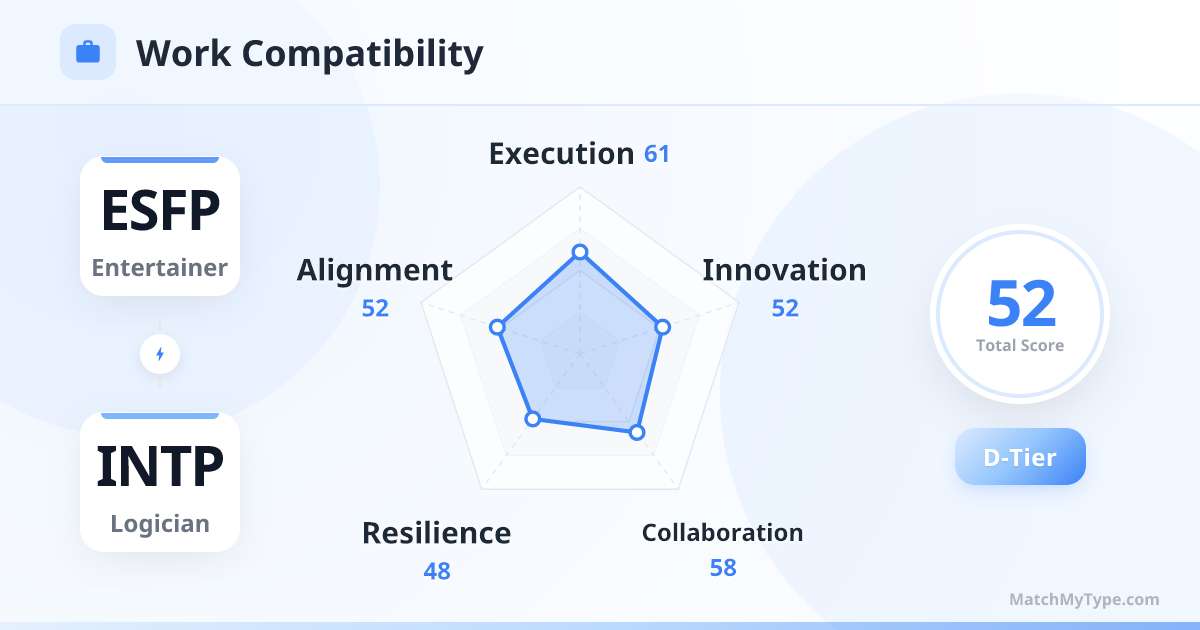
Synergy
A perfect model of 'to each their own.' INTP excels behind the scenes with high-quality solutions; ESFP excels on stage, translating dry tech-speak into stories clients love. ESFP can sense office politics, protecting the socially oblivious INTP.
Friction
Time management and execution details. ESFP gets distracted easily; INTP procrastinates by chasing perfection. Together, they might reach a deadline with INTP still tweaking the architecture and ESFP still gossiping, leading to a collective meltdown.
2. Boss-Subordinate and Peer Interactions
A as Boss (ESFP)
Motivational management. ESFP bosses love 'painting a vision' and team building, which confuses or embarrasses the INTP. ESFP needs to stop the fluff and give INTP specific tasks and independent space. Don't force INTP to chant slogans; letting them code in peace is the greatest blessing.
B as Boss (INTP)
Laissez-faire management. INTP bosses don't care about attendance or formalities, only results, which gives ESFP freedom. However, INTP's instructions are often vague (assuming you just 'get it'), so ESFP needs to confirm details. ESFP can act as INTP's 'diplomat,' handling social situations the boss wants to avoid.
Peer Colleagues
Physical isolation is best. If they sit together, ESFP will keep talking and sharing snacks, ruining INTP's flow. Clear division of labor is recommended: INTP handles docs and data, ESFP handles reports and PPT presentations.
3. Communication Manual
- To INTPLogic first. Don't say 'I think this looks good,' say 'This increases efficiency by 20%' or 'It's more logically consistent.' Give them time to think; don't demand instant feedback.
- To ESFPThe Sandwich Method. Praise their energy and contribution first, then gently point out the logical flaw, and end with encouragement. Direct criticism makes ESFP feel targeted and defensive.
- Meeting ModeESFP warms up the room and controls the pace; INTP provides core content. ESFP must not joke around when INTP is serious; INTP must not pour cold water on ESFP's attempts to liven things up.
4. What can they learn from each other?
This is a pair of allies who can cover each other's 'blind spots.' **ESFP from INTP**: How to think deeply before acting; how to see the essence through the noise; how to enjoy solitude. **INTP from ESFP**: How to take action instead of staying in theory; how to sense others' emotional shifts; how to dress and manage personal image.
FAQ
Social and Entertainment Mode
This is a 'Prom King/Queen' hanging out with the 'Valedictorian/Geek' mode. ESFP is the friend who drags INTP out of the house, and while INTP says no, they secretly enjoy the novelty ESFP brings.
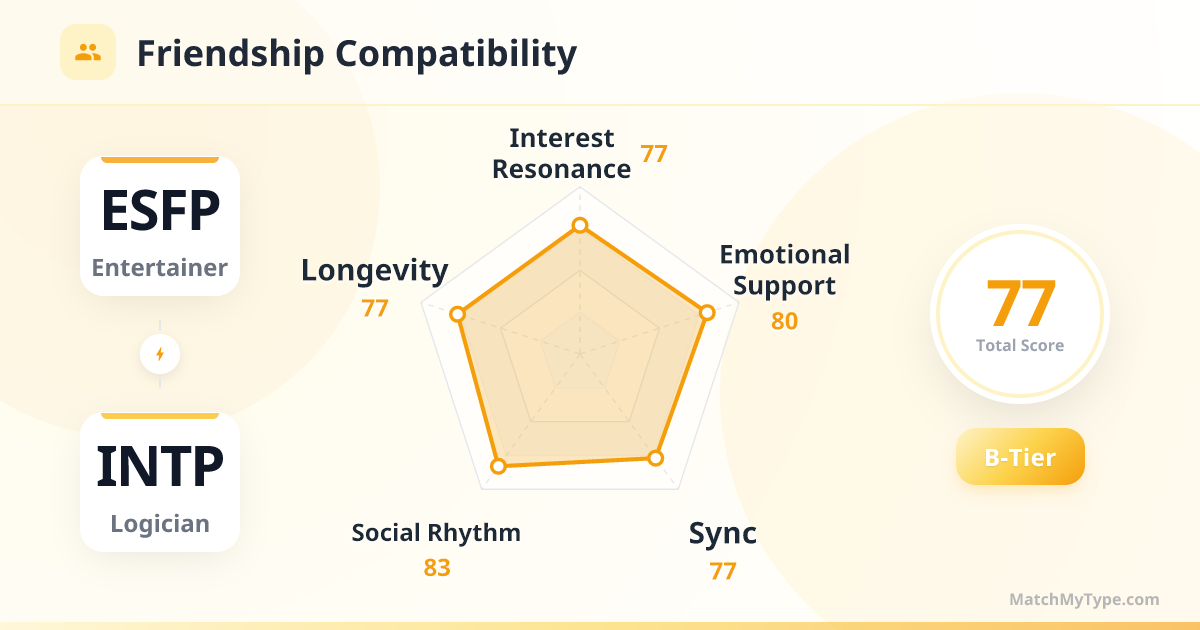
1. Social Energy Matching
Completely mismatched. ESFP is a nuclear power plant; INTP is a battery. ESFP recharges via socializing; INTP needs a day of recharge after an hour of socializing. ESFP must understand INTP's 'sudden disappearance' isn't a breakup—they're just out of juice. Best mode: ESFP hosts, INTP attends the first half, and is allowed to leave early after eating well.
2. Common Topics and Hobbies
Video games are the biggest overlap—INTP studies strategies and mechanics, ESFP enjoys the action and visuals. Escape rooms are great: INTP solves puzzles, ESFP finds clues and screams at NPCs (providing emotional value). Food is a universal language: ESFP knows what's good, INTP just needs to eat.
3. Travel Style Compatibility
ESFP likes packed itineraries and Instagrammable spots; INTP likes to be spontaneous or just read/play on their phone in a new place. Suggestion: ESFP plans and books (Se strength), but don't overpack. One 'highlight spot' per day for ESFP's social media, then let INTP zone out in a cafe. Don't force INTP into awkward poses for photos.
FAQ
Explore More Matches
Discover how these types interact with others