ESFP and ISTJ Compatibility
One breaks the rules for fun (ESFP), the other guards the order of reality (ISTJ)—it’s either a spectacular spark or a lifelong tug-of-war over who’s in charge
Real Stories
Deep Dive: Romance & Intimacy
This is a classic 'opposites attract' scenario. The ESFP is like a social butterfly bringing color and laughter into the ISTJ’s black-and-white world, while the ISTJ acts as a lighthouse, providing the drifting ESFP with a much-needed sense of security and direction. Though your habits are worlds apart, if you sync up, you become each other’s missing puzzle piece.
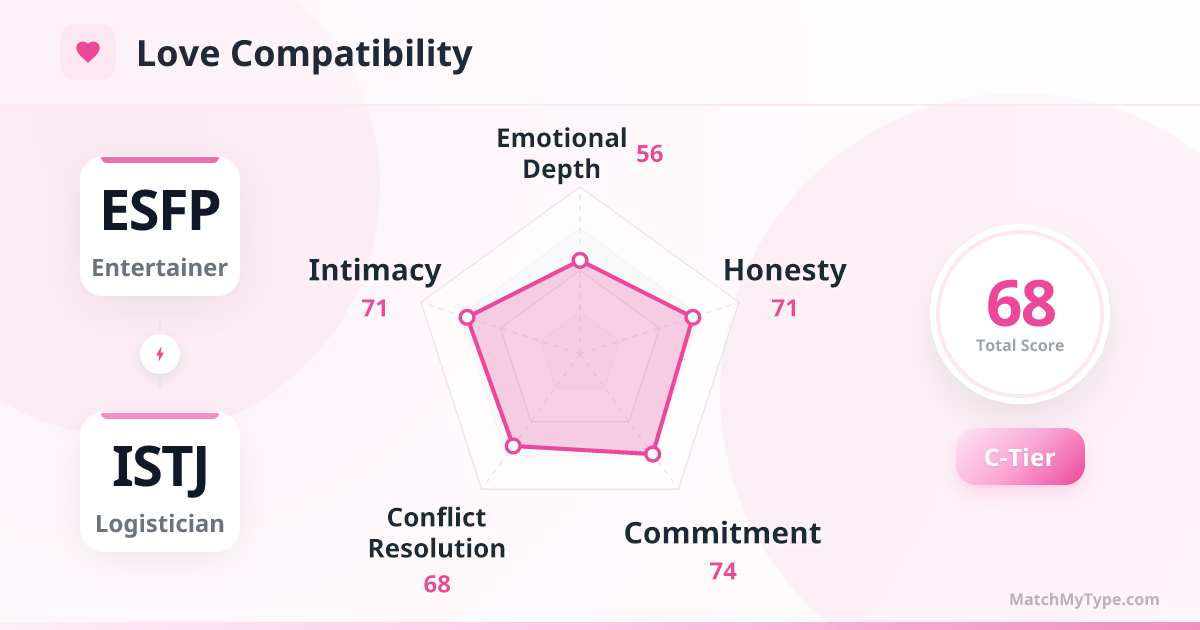
1. Why the Fatal Attraction?
ISTJs are often awestruck by the ESFP's sheer 'vitality'—how can someone live so lightly, shine so brightly, and care so little about tomorrow? The ESFP’s warmth can melt even the most stoic ISTJ face. Conversely, the ESFP, who often feels their life is a bit chaotic, is deeply drawn to the ISTJ’s stability, reliability, and 'get-it-done' attitude. To an ESFP, an ISTJ is the 'All-Powerful Butler' who can fix any mess—a grounding force they rarely find in other P-types.
2. The Brain Game (Jungian Functions)
While you differ on E/I and P/J, you actually share your middle functions: **Fi (Introverted Feeling)** and **Te (Extraverted Thinking)**, which is crucial. **Se (Extraverted Sensing) vs Si (Introverted Sensing)**: This is the main source of friction. The ESFP’s Se seeks novelty and lives for the moment ('Money is for spending!'); the ISTJ’s Si seeks stability and tradition ('Preparation is survival!'). The ESFP wants to hit the club; the ISTJ wants to deep-clean the house. **Te (Extraverted Thinking) Resonance**: The good news is that you are both pragmatic decision-makers. When problems arise, you don't get stuck in emotional loops like NF types; you focus on 'fixing it.' The ISTJ’s stronger Te helps organize the ESFP’s logic, while the ESFP’s Te respects the ISTJ’s practical advice.
Beware of **Fi (Introverted Feeling)** standoffs. Since both of you have Fi, you both hold deep personal values that you don't like to explain. During arguments, you can both become stubborn, thinking 'I'm right, you're being unreasonable,' and neither will yield easily for the sake of harmony.
3. Three Stages of the Relationship
Stage 1: The Complementary Honeymoon
ESFP takes ISTJ on wild adventures; ISTJ helps ESFP organize their messy life. Both enjoy the novelty of being 'completed' by their opposite.
Stage 2: The War of Order
The honeymoon ends. ISTJ gets annoyed by ESFP's lack of planning and spending habits, attempting to 'parent' them. ESFP feels suffocated by the rules and starts to rebel. This is the high-risk breakup zone.
Stage 3: Dynamic Equilibrium
If you survive Stage 2, you reach a truce: ISTJ manages the big picture and finances, while ESFP handles the social life and 'flavor.' ISTJ learns to embrace surprises, and ESFP learns to show up on time.
4. Intimacy & Physicality
Physically, both are S-types (Sensing), making you highly tuned into sensory experiences. This usually leads to great chemistry. ESFP is the passionate firestarter, loving new experiences and romantic vibes; ISTJ, though seemingly conservative, has incredible endurance and a strong 'service' mindset. Once they feel safe, ISTJs often reveal a surprisingly wild side to keep up with the ESFP. It’s a 'stoic on the outside, fire on the inside' combo.
5. Relationship Landmines
- 1**Financial Friction**: The biggest trigger. ISTJ will lose it over ESFP's 'useless' impulse buys; ESFP will lose it over ISTJ spending 30 minutes comparing prices to save two dollars.
- 2**Social Battery Mismatch**: ESFP wants a Saturday night party; ISTJ wants to recharge in silence. If forced to socialize, the ISTJ's 'resting grump face' will embarrass the ESFP.
- 3**Blunt Communication**: ISTJ speaks in facts and can ignore ESFP's need for emotional validation; ESFP’s emotional outbursts may be dismissed by ISTJ as 'irrational drama.'
FAQ
Workplace Collaboration Guide
In a professional setting, this is a high-efficiency 'Doer' duo. You don't waste time on abstract N-type theories; you just get to work. ESFP handles the people; ISTJ handles the process. With clear roles, you are a profit-making machine.
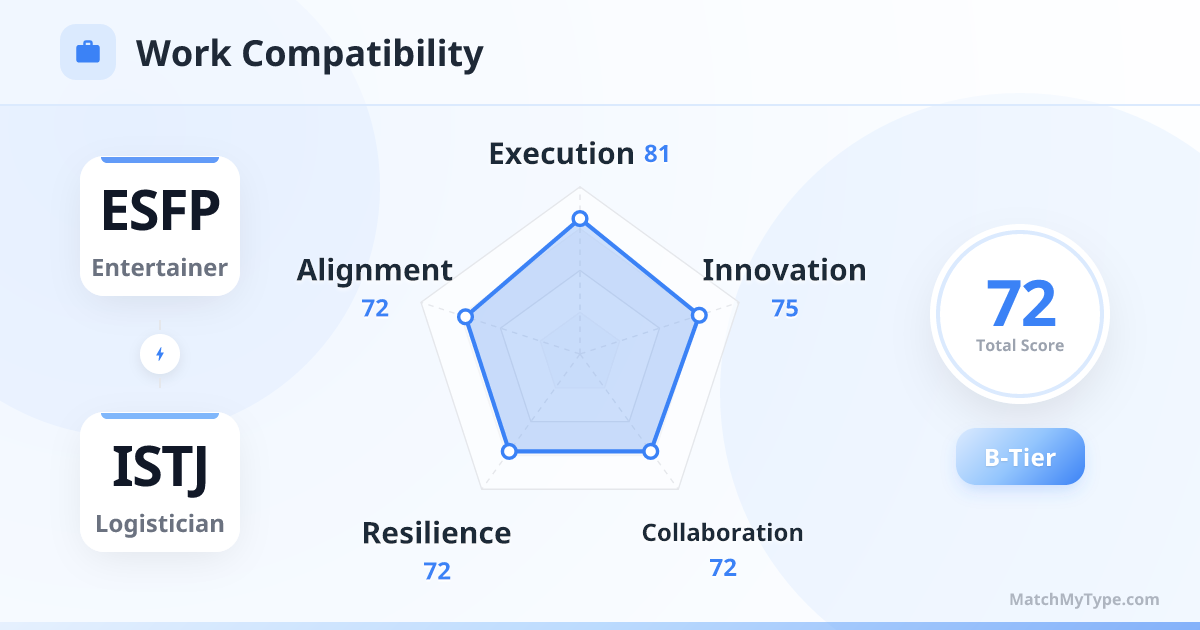
Synergy
The perfect 'Front-of-House and Back-of-House' pairing. ESFP has the charisma for sales, PR, and networking; ISTJ has the meticulous logic for finance, operations, and risk management. ESFP brings the clients in; ISTJ ensures the service is delivered perfectly.
Friction
Rhythm clashes. ISTJ likes to plan ahead and follow steps; ESFP thrives on improvisation. ISTJ may explode when an ESFP's 'last-minute idea' ruins a schedule, while ESFP feels stifled by ISTJ’s 'rigid bureaucracy.'
2. Hierarchy & Interaction
ESFP Boss
The Motivational Leader. Great at team building and 'selling the dream,' but instructions can be vague. The ISTJ subordinate will struggle without clear KPIs. ESFP bosses should delegate process-building to the ISTJ and focus on morale.
ISTJ Boss
The Drill Sergeant. Values results, punctuality, and protocol. The ESFP subordinate may feel like a robot. ISTJ bosses need to realize the ESFP's value lies in their 'people skills' and shouldn't chain them to a spreadsheet.
Peer Colleagues
Physical separation is best. Let the ESFP brainstorm in the noisy lounge while the ISTJ crunches numbers in a quiet corner. In meetings, ESFP keeps the energy up while ISTJ takes the minutes and tracks the to-do list.
3. Communication Manual
- ReportingTo ISTJ: Use data, logic, and timelines. No stories, no fluff. To ESFP: Use praise, feedback, and vivid examples. Don't start with a list of rules.
- Handling ErrorsIf ESFP messes up, ISTJ should never criticize them in public. If ISTJ messes up (rarely), ESFP shouldn't laugh it off; take it seriously, as ISTJ's pride is on the line.
- Project PushingISTJ: Give ESFP a hard deadline but don't micromanage the 'how.' ESFP: Respect the ISTJ’s process; don't dump your work on them an hour before the deadline.
4. Growth Perspective
This pair can literally save each other. **ESFP learns from ISTJ**: How to achieve long-term goals through discipline, how to manage money, and that being 'reliable' is more valuable than being 'interesting.' **ISTJ learns from ESFP**: How to loosen up, how to navigate complex social politics, and that 'life' is about more than just checking off a task list.
FAQ
Social & Leisure Patterns
You are the kind of friends who 'can't party together but can build a life together.' ESFP thinks ISTJ is a bore; ISTJ thinks ESFP is too loud. But if you team up to solve a concrete problem (like a road trip or a home reno), the bond becomes unbreakable.
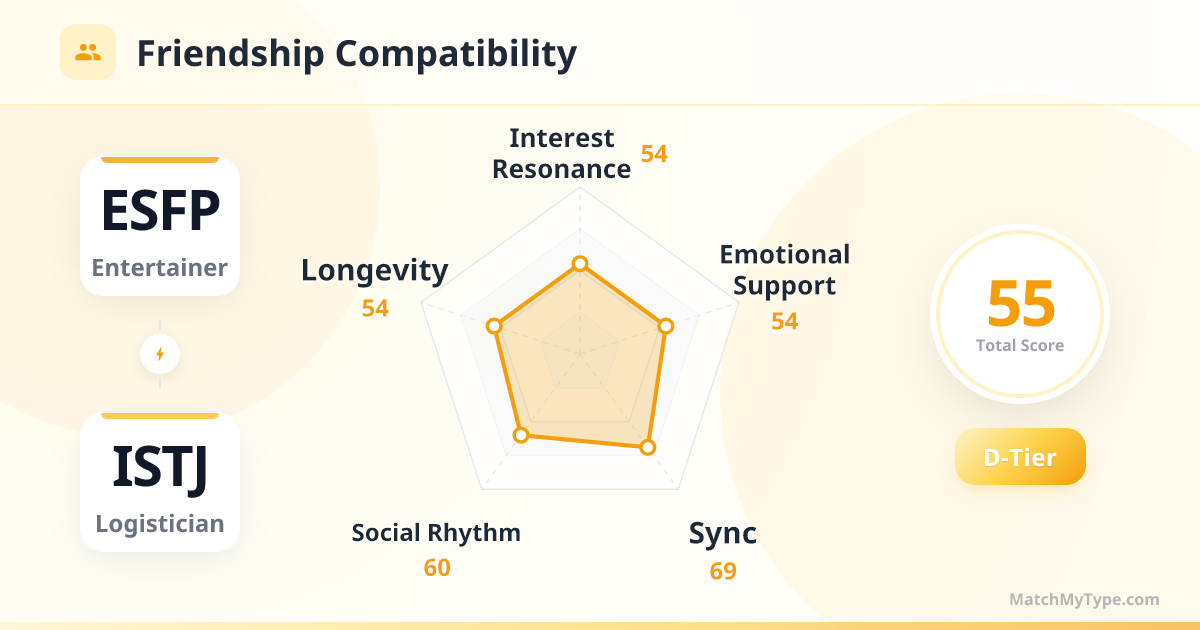
1. Social Energy Match
A total mismatch. ESFP is a social butterfly; ISTJ is a social hermit. At a party, ESFP is in the center of the dance floor while ISTJ is in the corner checking their phone or holding everyone's bags. ESFP shouldn't force ISTJ to mingle; ISTJ's mere presence at the party is already a huge gesture of love.
2. Common Ground
Both are S-types who love tangible sensory joys. Eating a great meal, hiking a trail, or even a trip to IKEA for furniture are perfect activities. ESFP finds the 'cool' spots; ISTJ checks the reviews and the route. As long as you avoid abstract philosophy, you'll have a blast.
3. Travel Compatibility
ISTJ travels like a soldier (itineraries, early starts); ESFP travels like a nomad (stopping for 30 minutes to pet a cat). Best fix: ISTJ books the flights and hotels (which ESFP hates), and ESFP picks the daily activities (where ISTJ lacks creativity). ISTJ must accept that plans will change; ESFP must promise to actually make it back to the hotel at night.
FAQ
Explore More Matches
Discover how these types interact with others