ISFJ and ISTJ Compatibility
Like two puzzle pieces fitting perfectly together, there's no explosive drama, just the steady rhythm of mutual understanding—arguably the world's most stable duo
Real Stories
Deep Dive: Romance & Intimacy
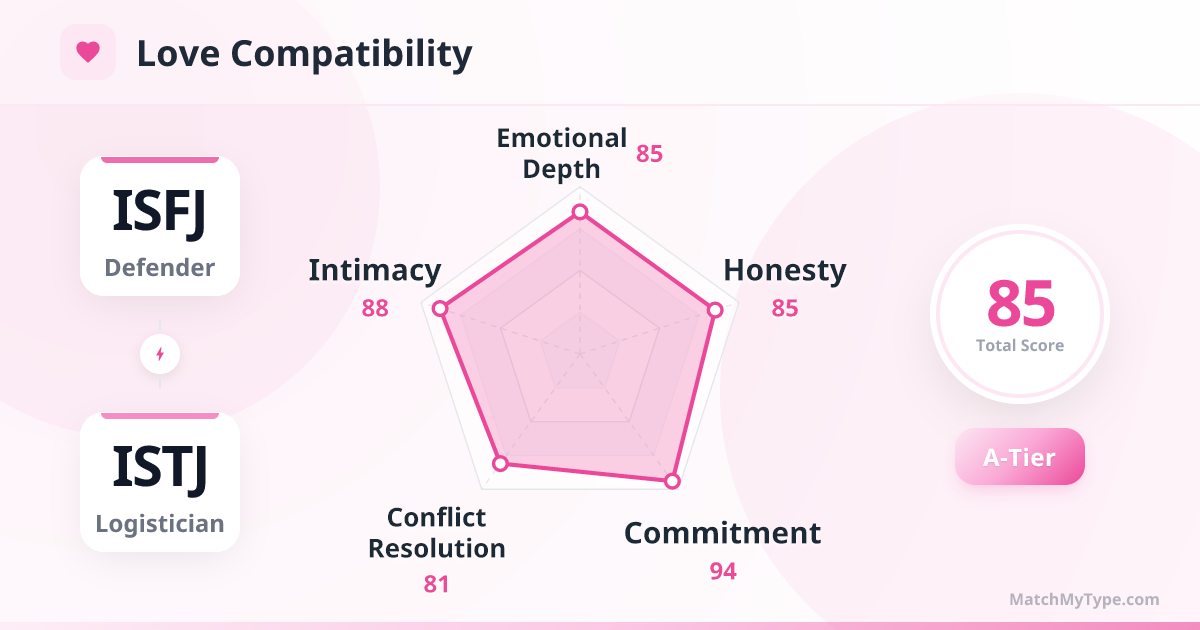
This isn't a roller coaster romance; it's a slow train traveling across the plains. The scenery might be predictable, but it's safe, punctual, and incredibly comfortable. ISFJs and ISTJs share an obsession with 'stability,' allowing them to build the sturdiest domestic fortresses in existence.
1. Why do they click?
It's the ultimate 'like attracts like' comfort. Both are Introverted Sensors (Si-dominant). In a volatile, uncertain world, they see rare qualities in each other: reliability, punctuality, and a deep respect for tradition and order. The ISFJ admires the ISTJ's steady decisiveness and sense of duty, which provides immense security for the often-anxious ISFJ. The ISTJ is moved by the ISFJ's warmth and their ability to keep life organized, seeing a partner truly built for 'real life.'
2. The Brain's Operating System (Jungian Functions)
Their underlying logic is highly consistent, though they differ in how they make judgments: **Si (Introverted Sensing) Resonance**: This is the relationship's cornerstone. Both have powerful internal databases, value past experiences, and love fixed routines. Friday movie nights and Sunday morning deep cleans eliminate 90% of life's friction. **Fe (Extraverted Feeling) vs Te (Extraverted Thinking)**: This is the main friction point. ISFJ's Fe asks 'Will this hurt feelings?' and tends toward indirect expression; ISTJ's Te asks 'Is this efficient?' and goes straight for the solution. ISFJ might see ISTJ as cold-blooded, while ISTJ might see ISFJ as oversensitive or illogical. **Ne (Extraverted Intuition) Inferior**: Both have Ne in the fourth position. They fear sudden changes and aren't great at innovation or chaos. Major life upheavals can lead to mutual anxiety paralysis.
3. Three Stages of the Relationship
Stage 1: Observation & Testing
A very slow burn. Neither will confess easily; instead, they show interest through practical actions like fixing a computer or bringing breakfast. It's a silent confirmation of reliability.
Stage 2: Adjustment & Formatting
Once official, they quickly establish a shared life routine. The challenge is that the ISFJ's need for emotional 'heart-to-hearts' might be dismissed by the ISTJ as 'inefficient communication.'
Stage 3: Symbiosis & Rigidity
They enter a hyper-stable 'old married couple' mode. The risk is that life becomes too procedural. Without intentional novelty, it can turn into a mere 'business partnership for living.'
4. Intimacy & Sex
In private, this duo is conservative but deeply affectionate. Sex is not just physical; it's a ritual that confirms 'the relationship is stable.' ISTJs tend to view it as a routine or responsibility, being direct and technique-oriented. ISFJs need significant emotional buildup and gentle foreplay. If the ISTJ is too mechanical, the ISFJ feels objectified. ISTJs should offer more verbal praise, while ISFJs should provide clear 'operating instructions,' as ISTJs truly want to succeed at their tasks.
5. Relationship Landmines
- 1**Emotional Temperature Gap**: ISFJ wants a hug; ISTJ gives a 3-step solution. This mismatch can leave the ISFJ feeling profoundly lonely.
- 2**Excessive Rigidity**: Both can get stuck in their ways, refusing to try new restaurants or travel destinations, leading to a stagnant life.
- 3**Cold War Risk**: ISFJs tend to sulk (waiting to be noticed), while ISTJs either don't notice or think 'if you don't say it, it's fine.' This leads to resentment snowballing.
FAQ
Workplace Collaboration Guide
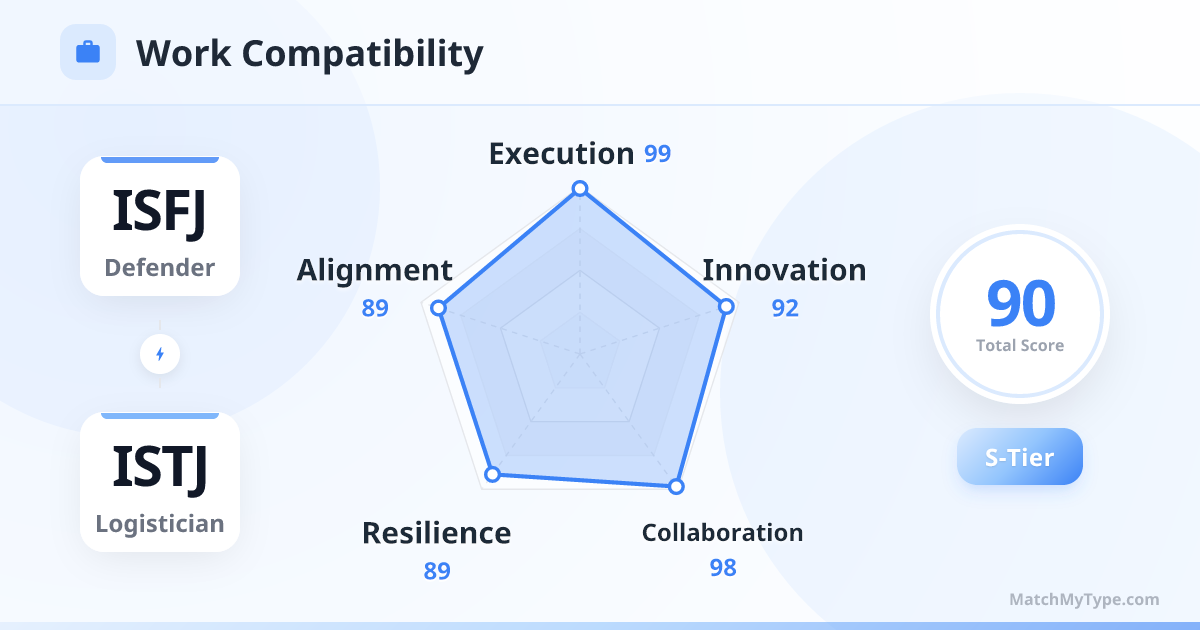
This is the most efficient, headache-free execution duo in the workplace. If a company were staffed entirely by ISFJs and ISTJs, there might not be a talent show at the annual party, but the financial reports and project deliveries would be flawless.
Synergy
Ultimate execution and closing ability. ISTJs set rigorous processes and logical frameworks; ISFJs maintain team morale and handle administrative details and client care. Both are punctual and responsible—you'll never have to track them down. They are a powerhouse in finance, law, healthcare, and administration.
Friction
A lack of flexibility and innovation. When the market shifts or a 'brainstorming' session is required, both feel uncomfortable. You risk falling into the trap of 'process for the sake of process' and missing strategic shifts while obsessing over details.
2. Hierarchy & Peer Interactions
ISFJ as Boss
The Gentle Guardian. They care deeply for subordinates but may lack ruthlessness. An ISTJ subordinate will appreciate the stability but may get frustrated when the boss prioritizes 'feelings' over cold, necessary business decisions.
ISTJ as Boss
The Strict Commander. Instructions are clear, and rewards are merit-based. This makes the ISFJ feel secure. However, the ISTJ might overlook the ISFJ's workload (as ISFJs struggle to say no), leading to silent burnout.
As Peers
Tacit partners. No fluff needed; a simple nod confirms progress. Recommended split: ISTJ handles data and logic; ISFJ handles personnel and communication. Avoid putting both on a project requiring high creativity, like ad ideation.
3. Communication Manual
- Email/Messaging StyleStructured with clear bullet points. No long voice notes or prose. List points 1, 2, and 3 with clear deadlines and owners.
- Meeting StrategyPunctuality is non-negotiable. Meetings must have a clear agenda. ISFJ can warm up the room; ISTJ should drive the conclusions.
- Feedback MethodFor ISTJ: Stick to facts and data ('This process is 10% less efficient'). For ISFJ: Acknowledge their hard work first, then suggest adjustments ('You've done great; it would be perfect if we tweaked this').
4. Mutual Growth (The Learning Perspective)
This pair acts as mirrors to correct each other's excesses. **ISFJ learns from ISTJ**: How to view problems objectively without being overwhelmed by emotion; how to say no and set boundaries. **ISTJ learns from ISFJ**: How to communicate with warmth; understanding that 'logical correctness' doesn't always equal 'effective results'; paying attention to the emotional needs of others.
FAQ
Social & Leisure Mode
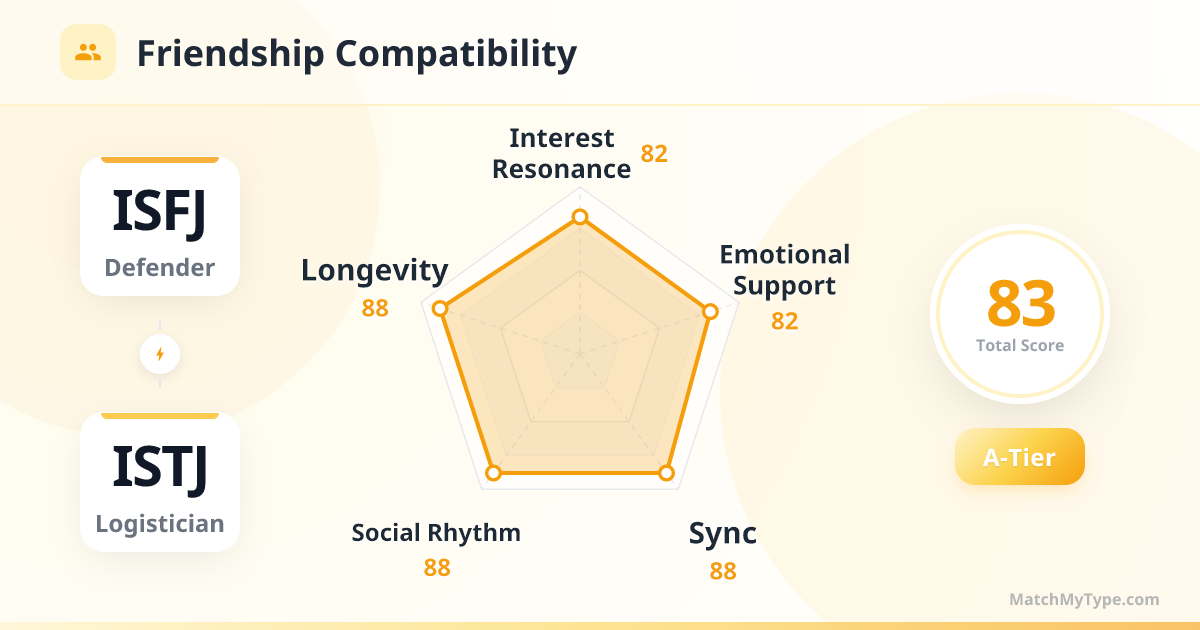
Your friendship is a 'gentleman's agreement.' You don't need to be together every day, but if one needs to move house, borrow money, or watch a pet, the other is there without question. This is a deep bond built on honor and time.
1. Social Energy Match
Both are Introverts (I), meaning you both dislike noisy, crowded, or uncontrollable social settings like clubs. Your hangouts are low-energy: cooking at home, walking in a quiet park, or just reading together in silence. This 'no-pressure' silence isn't awkward; it's restorative.
2. Common Interests
You both love 'tangible' results. Perfecting a complex recipe or assembling IKEA furniture brings immense satisfaction. You likely share interests in history, traditional culture, or specific skill-building.
3. Travel Compatibility
This is the gold standard of travel duos. Both will plan the itinerary three months in advance, down to the exact train time. ISFJ finds the best food and cozy stays; ISTJ plans the route and manages the budget. No one sleeps until noon or suggests an 'impromptu' mountain climb.
FAQ
Explore More Matches
Discover how these types interact with others