ISFP and ISTJ Compatibility
ISTJ builds the house to weather the storm, while ISFP fills it with flowers—a sense of security where the free wind is gently embraced by solid walls
Want specific advice?
Generate a unique analysis report based on star sign, blood type, identity, and gender.
In-Depth Analysis: Love and Intimacy
This is a classic 'complementary' pairing. ISFP brings color, emotion, and present-moment joy; ISTJ brings structure, security, and future stability. While one is a spontaneous artist and the other a rigorous administrator, both are pragmatic S-types and reserved I-types, forming a solid foundation of 'silence is golden' understanding.
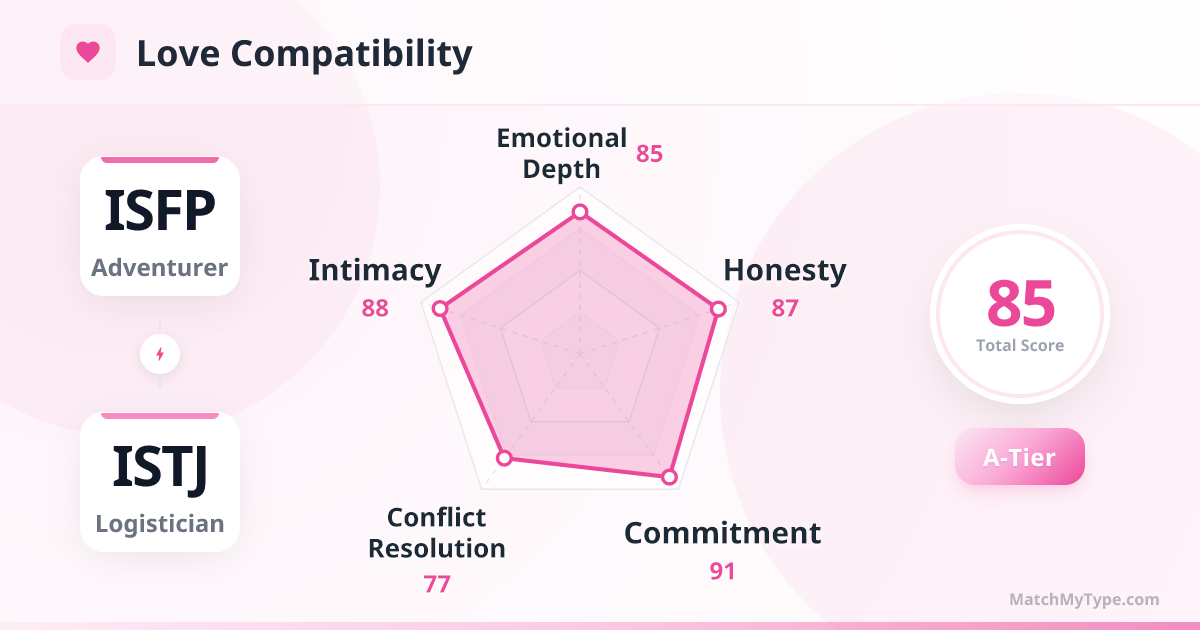
1. Why the Spark?
ISTJs are often drawn to the ISFP's effortless ease, unique aesthetic, and 'live in the moment' relaxation—a splash of color in the ISTJ's tightly wound world. Conversely, ISFPs are deeply impressed by the ISTJ's reliability, composure, and problem-solving prowess. For an ISFP who may feel insecure or lost in life's mundane details, the ISTJ acts as a solid anchor, providing an unprecedented sense of stability. This attraction stems from completing each other's 'shadow' functions.
2. The Cognitive Tug-of-War
At the cognitive level, this is a collision of order and sensation: **Fi (Introverted Feeling) Resonance & Dissonance**: ISFP is Fi-dominant, with delicate emotions that must stay true to the self. ISTJ has Fi as a tertiary function; though they aren't expressive, they hold firm inner values. This means they often share a silent understanding of core ethics. **Se (Extraverted Sensing) vs. Si (Introverted Sensing)**: This is the primary point of both complement and conflict. ISTJ’s Si relies on past experience, habit, and planning, seeking predictability. ISFP’s Se seeks new experiences, beauty, and spontaneity. The ISTJ keeps life organized, while the ISFP creates surprises within those boundaries. ISTJ is the frame, and ISFP is the paint.
The biggest risk lies in the **Te (Extraverted Thinking)** imbalance. ISTJ’s Te is strong and direct, favoring commands and efficiency. ISFP’s Te is their inferior function, making them loathe being ordered around or rushed. If an ISTJ tries to manage their partner like a subordinate, the ISFP will feel controlled and react with fierce rebellion.
3. Three Stages of the Relationship
Stage 1: The Complementary Honeymoon
ISFP thinks ISTJ is incredibly cool and capable; ISTJ thinks ISFP is adorable and fun. They enjoy quiet time together where even silence isn't awkward.
Stage 2: The War of Order
Conflicts erupt over lifestyle habits. ISTJ can't stand ISFP's clutter, lateness, or lack of planning; ISFP sees ISTJ as a rigid schoolmaster—boring and suffocating. The more ISTJ tries to control, the more ISFP wants to escape.
Stage 3: Division and Respect
ISTJ learns to 'pick their battles,' managing the big things while letting go of the small stuff. ISFP learns to keep promises on key matters. They form a perfect 'unspoken division of labor,' creating a life that is both orderly and soulful.
4. Intimacy and Physicality
As two Sensing (S) types, they are highly attuned to physical touch and sensory experiences. Their sex life is usually harmonious and high-quality. ISTJs often show more passion and stamina in the bedroom than in daily life, which surprises and delights the ISFP. ISFP, in turn, can guide the ISTJ toward more sensual and tender expressions. They prefer showing love through hugs, touch, and action rather than verbal flirtation.
5. Relationship Red Flags
- 1**ISTJ's Preaching**: Avoid saying 'You should...' or 'That's illogical' to dismiss ISFP's feelings. To an ISFP, feelings are facts.
- 2**ISFP's Emotional Avoidance**: When facing issues, ISFPs tend to retreat into their shells, which drives the solution-oriented ISTJ crazy. Try to speak your feelings instead of giving the silent treatment.
- 3**Financial Friction**: ISTJ loves saving and budgeting; ISFP loves spending on moods and aesthetics. Set up a 'Happiness Fund' that the ISFP can spend freely without interference.
FAQ
Workplace Collaboration Guide
This is an excellent 'doer' duo. As long as the work doesn't involve too much abstract strategic planning, you are a golden team in execution. ISTJ builds the process and the skeleton; ISFP fills in the content and beautifies the exterior.
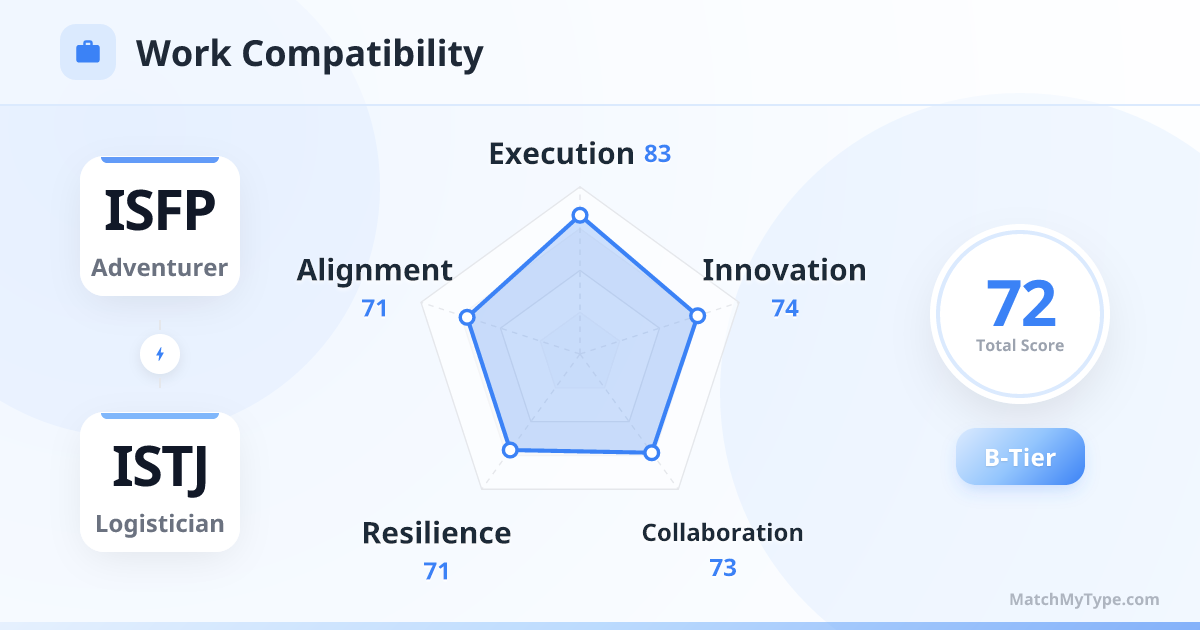
Synergy
A blend of process and aesthetics. In fields like product design, construction, or event planning, ISTJ ensures the project stays on time and on budget, handling the dry admin work; ISFP ensures the final output has high aesthetic standards and a great user experience. ISTJ provides the structural support ISFP often lacks.
Friction
Conflicts in pace and rhythm. ISTJ loves planning ahead and hates sudden changes; ISFP prefers working when inspiration strikes and dislikes rigid deadlines. ISTJ might see ISFP as procrastinating; ISFP might see ISTJ as a rigid bureaucrat who kills creativity.
2. Power Dynamics
ISTJ as Boss
The strict supervisor. ISTJ bosses value attendance, reports, and standards. This can be torture for the spontaneous ISFP. The ISTJ boss should set clear result-based standards rather than micromanaging the process or clock-in times.
ISFP as Boss
The hands-off leader. ISFP bosses are usually gentle and dislike controlling others, which can confuse an ISTJ subordinate: 'What is the standard? What is the next step?' The ISTJ should step up as an 'invisible manager' to help create the workflow.
Peer Colleagues
Parallel lines that don't interfere. It's best to have a clear division of labor. ISTJ shouldn't comment on how messy ISFP's desk is as long as they deliver; ISFP shouldn't interrupt an ISTJ in deep focus.
3. Communication Manual
- Giving InstructionsWhen ISTJ makes a request, use a soft tone ('Please', 'Help me out') and explain the value to others (appealing to Fi). When ISFP makes a request, be specific and logical, stating time, place, and purpose (satisfying Te).
- Meeting StrategyNeither likes long, useless meetings. Keep them short and bulleted. ISTJ handles recording and tracking; ISFP provides the perspective on 'people' and 'experience'.
- Conflict ResolutionFocus on the facts. ISTJ should not bring up past mistakes or attack character; ISFP should not take professional criticism as a personal insult.
4. Mutual Growth
**ISTJ learns from ISFP**: How to relax, enjoy the scenery, keep a touch of humanity within the rules, and improve their sense of aesthetics. **ISFP learns from ISTJ**: How to create actionable plans and stick to them, how to handle problems rationally without being swayed by emotion, and how to manage finances and time.
FAQ
Social and Leisure Patterns
You are the kind of friends who don't need to force conversation. You can sit in a cafe for an afternoon, reading or on your phones, occasionally chatting without any awkwardness. It is low-energy, high-quality companionship.
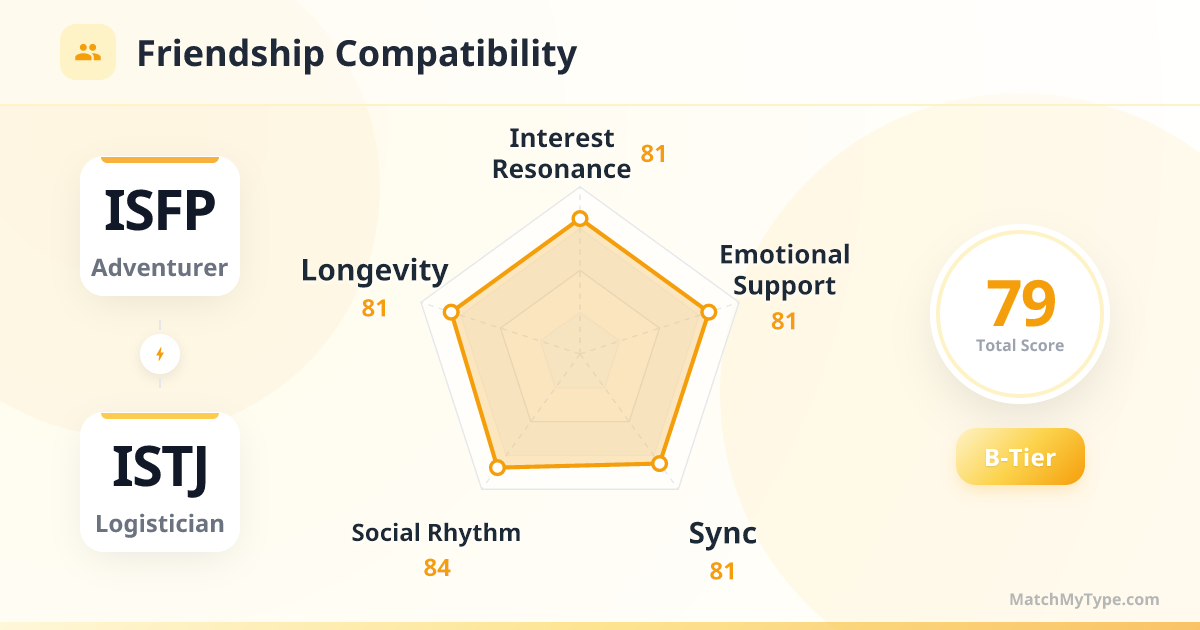
1. Social Energy Match
Both are introverts (I) who dislike noisy, large gatherings. You are each other's best 'shield.' If invited to a party you don't want to attend, you'll tactfully cover for each other. You don't need to meet often, but the quality of each meeting is very stable.
2. Shared Interests
As Sensing types, your connection lies in 'enjoying the physical world.' Go for a gourmet meal, hike in nature, or build LEGO/pottery together. ISTJ enjoys the 'achievement' of these activities, while ISFP enjoys the 'experience'—different paths to the same joy.
3. Travel Compatibility
ISTJ will have an Excel sheet with exact bus times; ISFP wants to sleep until they wake up and wander based on their mood. Solution: ISTJ handles the major transport and hotels (security), but once there, let ISFP take the lead or schedule only one 'must-see' per day, leaving the rest for 'blind box' exploration with ISFP.
FAQ
AI Deep Pairing Analysis
Provide more details allow AI to give precise compatibility guidance based on ISFP x ISTJ, zodiac, and blood type.
ISFP Info
ISTJ Info
*Unlock detailed character & complement analysis
Explore More Matches
Discover how these types interact with others