ESFP and ISTP Compatibility
When the hottest flame meets the coolest ice, it’s a grand celebration of the here and now—as long as we're happy today, who cares if the world ends tomorrow
Want specific advice?
Generate a unique analysis report based on star sign, blood type, identity, and gender.
Deep Dive: Romance & Intimacy
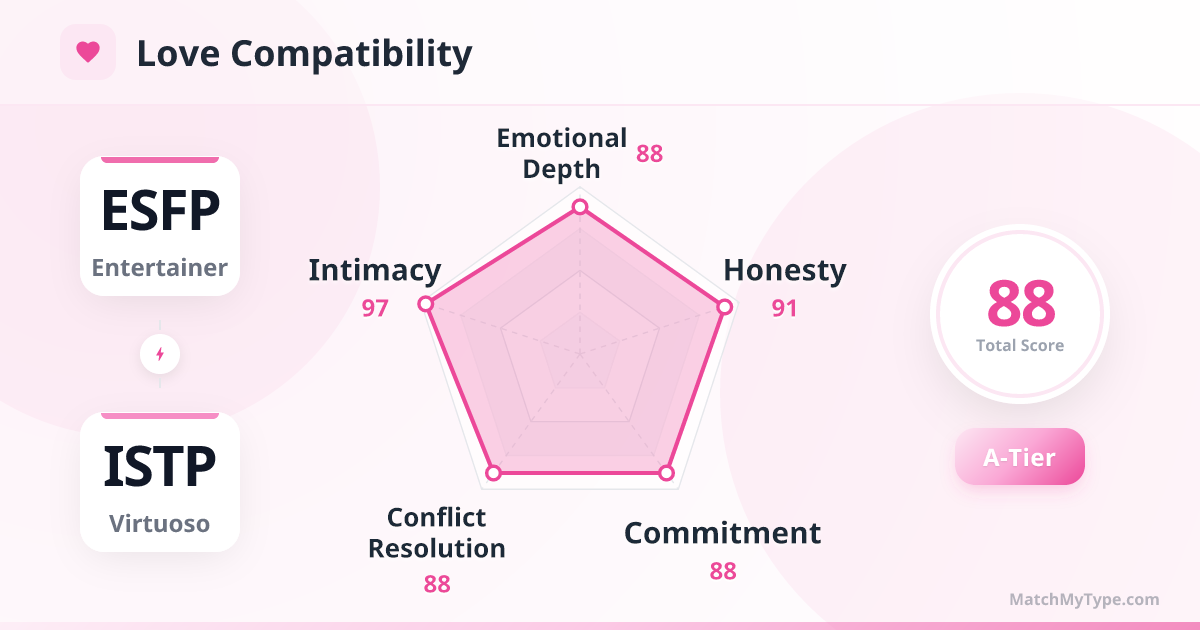
An ESFP and ISTP relationship is like a shot of high-proof liquor with popping candy—intense, direct, and intoxicating. Neither of you enjoys fluff; instead of debating the 'definition of love,' you'd rather book a flight to go surfing. This is a bond built on 'shared experiences' rather than 'spiritual discourse,' dripping with dopamine.
1. Why the Fatal Attraction?
It’s the classic 'Cool Guy meets Sweetheart' dynamic. ESFP is drawn to ISTP’s mysterious, low-key, hands-on, and 'don't care' vibe. ISTP is melted by ESFP’s unreserved passion, vivid energy, and ability to light up a room instantly. ESFP is the color in ISTP’s grayscale world; ISTP is the anchor in ESFP’s chaotic life.
2. The Cognitive Tug-of-War (Jungian Functions)
This is a tug-of-war between sensory feast and logical emotion: **Se (Extroverted Sensing) Resonance**: The cornerstone. Both are high Se users, living in the moment and chasing sensory thrills. You can instantly agree on 'hotpot then street racing' without any planning baggage. This sync makes being together incredibly easy. **Fi (Introverted Feeling) x Ti (Introverted Thinking)**: The main friction point. ESFP decides based on 'Do I like this?' (Fi); ISTP decides based on 'Does this make sense?' (Ti). When ESFP wants emotional validation, ISTP might coldly analyze pros and cons, leading ESFP to think ISTP is 'cold-blooded' and ISTP to think ESFP is 'irrational.'
The risk lies in **Ni (Introverted Intuition)** being a weak spot for both. You both tend to focus on the immediate, lacking long-term vision. This can lead to a 'live for today' lifestyle, only to realize neither of you saved money or made a plan when facing major life milestones like buying a home or career crises.
3. Three Stages of the Relationship
Stage 1: The Playmate Effect
An incredibly joyful honeymoon phase. You’ll game, work out, and explore new spots together, realizing you’ve found the world’s best playmate. ESFP's initiative makes the slow-to-warm ISTP comfortable; ISTP's competence earns ESFP's admiration.
Stage 2: Cling vs. Escape
ESFP starts getting serious, craving high-frequency interaction and verbal affection (Fi needs). ISTP begins to feel their private space is being invaded and instinctively pulls back (Ti independence). The more ESFP chases, the more ISTP runs, leading to a 'cat-and-mouse' game.
Stage 3: Dynamic Equilibrium
If you survive the friction, ESFP learns to find their own fun without hovering over ISTP; ISTP learns to play along with ESFP's 'drama' occasionally and give necessary responses. You become back-to-back comrades: independent, but ready to charge together.
4. Intimacy & Sex
In terms of physical chemistry, this is one of the most harmonious combos in the MBTI. Dominant Se makes both value touch, visuals, and immediate pleasure. You don't care for flowery or awkward foreplay; you prefer direct, passionate, and skillful interaction. ESFP loves to please and express, while ISTP excels at exploring and responding. 'Makeup sex' is often your (unhealthy but effective) way of resolving arguments.
5. Relationship Landmines
- 1**ESFP's Emotional Drama**: ESFP might blow things out of proportion to get attention, which hits ISTP's limit and causes them to 'shut down' and refuse communication.
- 2**ISTP's Cold Violence**: When faced with illogical emotional issues, ISTP habitually goes silent or disappears. This is devastating for ESFP, triggering extreme insecurity.
- 3**Mutual Name-Calling**: ESFP calling ISTP a 'robot' and ISTP calling ESFP 'irrational' or 'brainless.'
FAQ
Workplace Collaboration Guide
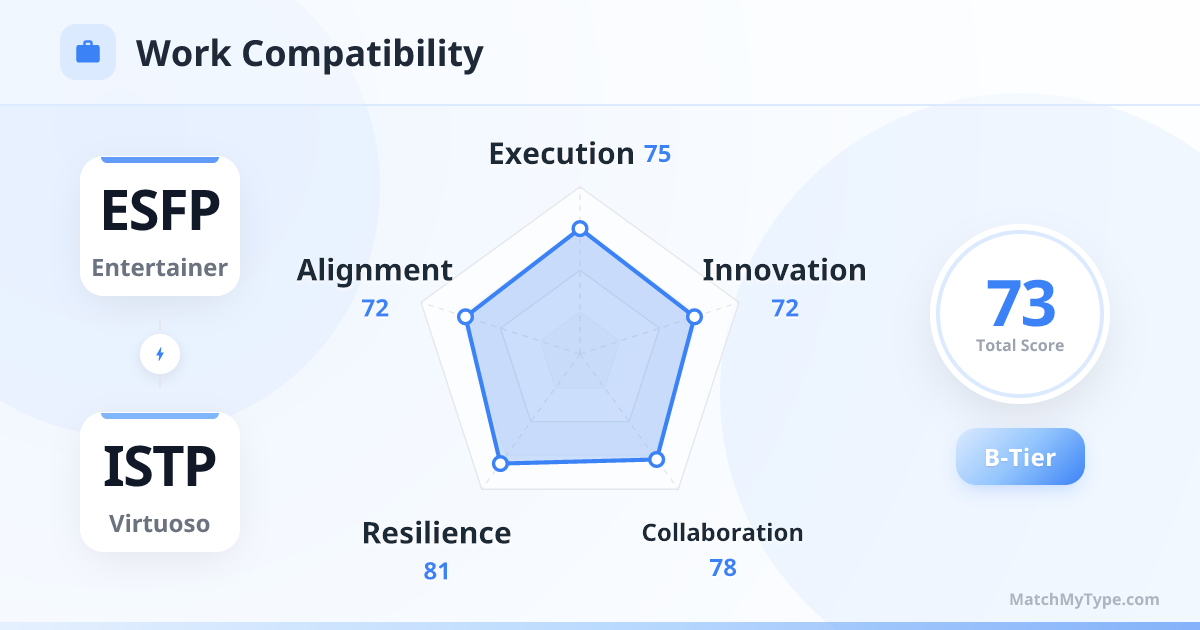
In the workplace, you are the 'Crisis Management Team.' When the office is on fire, the server is down, or a client is screaming, you are the coolest and most efficient firefighters. But if it's an annual strategy PPT or dry theoretical research, you might end up slacking off together.
Synergy
Action levels are off the charts. ESFP is great at handling 'people,' while ISTP is great at handling 'things.' In sales, PR, emergency response, or entertainment, ESFP shines on stage while ISTP solves technical puzzles backstage. It’s a seamless fit.
Friction
When it comes to long-term planning, abstract theory, or complex admin, both will suffer. ESFP gets distracted by boredom, and ISTP gets passive-aggressive because it feels 'pointless.' Without supervision, projects might never reach the finish line.
2. Boss & Peer Dynamics
ESFP as Boss
The inspirational leader. ESFP is great at 'selling the dream' and team building. ISTP employees will appreciate the lack of micromanagement but will hate emotional inconsistency. ESFP: Give ISTP a clear task and deadline, then shut up and let them work.
ISTP as Boss
The 'hands-off' leader. ISTP cares about results, not the process. ESFP employees might feel neglected due to a lack of feedback and praise. ISTP needs to learn to compliment ESFP occasionally—it doubles their productivity.
As Peers
The ultimate slacking buddies and strike team. You’ll bond over complaining about company rules or sneaking out for coffee. But during a crunch, you’ll work side-by-side all night to solve the problem with high efficiency.
3. Communication Manual
- Directives for ISTPKeep it simple, direct, and logical. Cut the emotional fluff. Tell them what's broken, what the goal is, and when it's due.
- Suggestions for ESFPAffirm first, then suggest. Keep the tone light and humorous. Never criticize an ESFP in public; they will get defensive and might snap immediately.
- Meeting ModeKeep meetings as short as possible. Both types hate long, theoretical meetings. Stand-up meetings or on-site huddles work best.
4. Mutual Growth (The Learning Curve)
ESFP can learn from ISTP how to **detach emotions from problems**, maintaining logical judgment during crises instead of panicking. ISTP can learn from ESFP how to **build human connections**, using warmth to dissolve awkwardness and expressing feelings more frankly instead of being a perpetual enigma.
FAQ
Social & Entertainment Mode
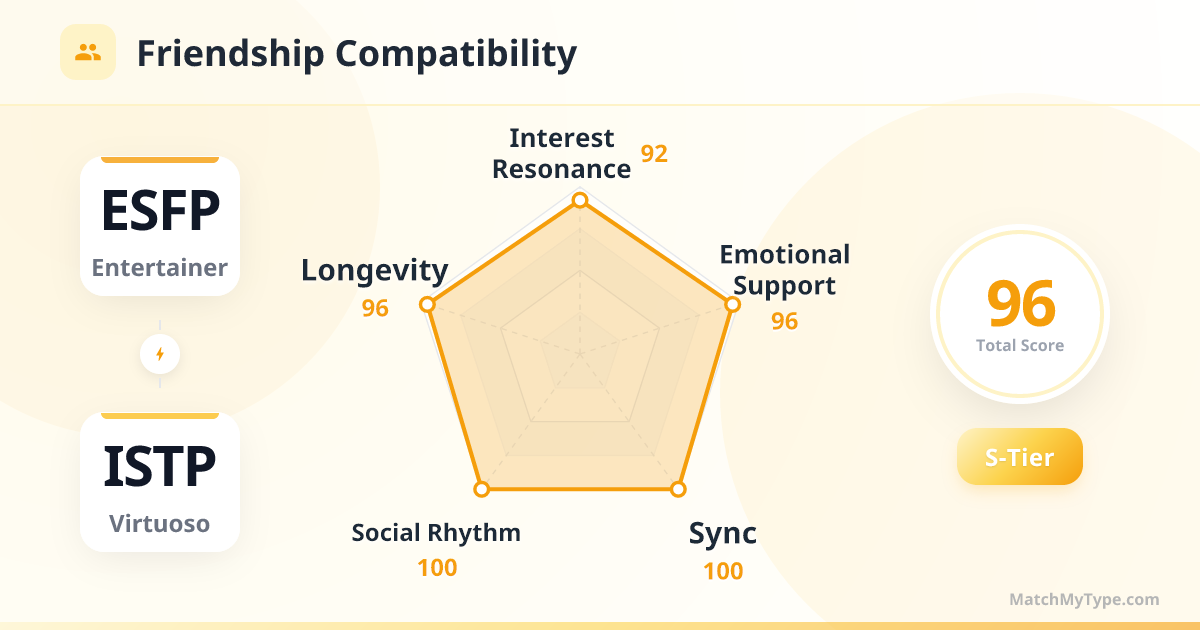
In your social circle, you're the 'never grew up' besties. Your friendship doesn't need midnight heart-to-hearts; it just needs a spontaneous road trip or an all-night gaming session.
1. Social Energy Match
ESFP is the social butterfly; ISTP is the social observer. At a party, ESFP heats up the room while ISTP sits coolly in the corner with a drink, occasionally dropping a witty one-liner that kills. ESFP protects ISTP from bores, and ISTP carries ESFP home when they've had one too many. It’s a perfect 'active-passive' combo.
2. Shared Hobbies
Anything involving 'hands-on' experience is a win. From modding cars and skiing to checking out the latest viral restaurant. You both have high standards for the material world and can spend hours discussing headphone audio quality, fabric textures, or engine specs.
3. Travel Compatibility
You are the best travel duo. Neither of you likes minute-by-minute Excel itineraries. You usually pick a destination and see how you feel when you land. ESFP finds the fun spots, and ISTP handles the map, navigation, and emergencies (like a flat tire). As long as you don't force ISTP into 'Instagram-only' tourist traps, everything is perfect.
FAQ
AI Deep Pairing Analysis
Provide more details allow AI to give precise compatibility guidance based on ESFP x ISTP, zodiac, and blood type.
ESFP Info
ISTP Info
*Unlock detailed character & complement analysis
Explore More Matches
Discover how these types interact with others